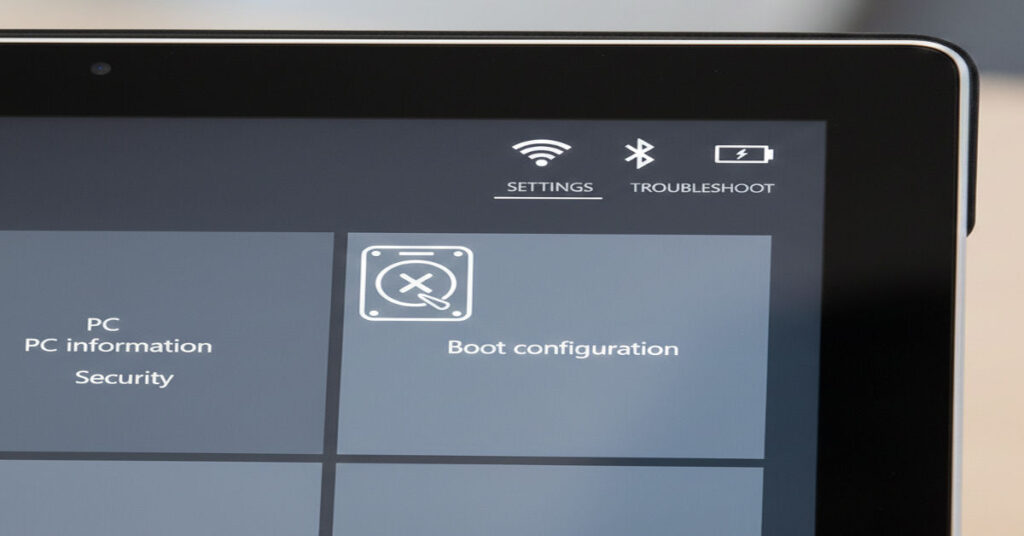

Microsoft Surface devices have become staples in both professional and personal computing, but navigating their UEFI screens can be perplexing for users unfamiliar with firmware-level indicators. Surface UEFI displays small icons in the top-right corner that convey critical device status, particularly during boot or firmware access. While subtle, these icons carry actionable insights confirm standard access, while others signal hardware issues, failed boots or storage detection problems.
When you power on a Surface and enter UEFI—either through Settings > Recovery > Advanced Startup > UEFI Firmware or by holding the volume up button during boot—the top-right corner icons serve as your diagnostic dashboard. For instance, a chip or gear symbol generally indicates a successful entry into UEFI settings, requiring no further action. Conversely, a hard drive with a slash warns of a missing bootable OS or undetected storage, which can arise from drive wipes or hardware faults. Memory chip icons may signal memory-related settings, occasionally reflecting stability issues, though routine Surface users seldom need adjustments here.
Recognizing these icons early allows users to preempt problems, make informed firmware changes, or perform recovery operations. In this guide, we unpack the Surface UEFI top-right icons, share troubleshooting strategies, and illustrate how to interpret and respond to each visual cue effectively.
The Chip or Gear Icon: Firmware Access Confirmation
This icon represents standard UEFI access and typically appears when the Surface firmware interface loads successfully. It signals that the system is ready for configuration adjustments, secure boot toggles, or diagnostic checks. According to Lena Moritz, Technology and Crypto Correspondent, “The gear symbol is a confirmation rather than a warning. Users often misinterpret it as an error, but it confirms the firmware is ready for navigation.” Repeated exposure and firsthand navigation of these menus reveal that the icon rarely coincides with functional problems unless paired with other alerts.
Hard Drive with Slash: No Bootable OS Detected
When the top-right corner shows a hard drive with a line, the device cannot locate a bootable operating system. This can occur after system wipes, corrupted Windows installations, or disconnected storage. Practical steps include verifying the boot order, checking for Windows Boot Manager, or using Surface recovery tools.
| Common Cause | Suggested Action |
| Drive wipe or OS deletion | Boot from USB recovery drive |
| Storage not recognized | Check UEFI boot order, reconnect SSD |
| Corrupted system | Perform Surface recovery procedure |
Marcus Reed notes, “From a risk perspective, understanding this icon is crucial for preventing operational downtime, especially in enterprise environments where Surface devices are integral to workflow.” Immediate attention to this icon minimizes data access interruptions and hardware misdiagnosis.
Memory Chip/Cog Icon: Understanding Memory Status
This icon often signals memory-related information or advanced settings. Overclocking scenarios can trigger warnings, though standard users rarely need adjustments. It provides insight into firmware detection of RAM and stability.
| Memory Icon Appearance | Typical Interpretation |
| Static chip/cog | Normal memory recognition, no action required |
| Flashing or error | Potential RAM issues or overclock conflicts |
Lena Moritz adds, “These icons give technical insight but should be interpreted with caution. Surface devices are designed with stable memory defaults; interference usually comes from specialized configurations.”
Entry Methods and Icon Variation
Icons differ depending on how UEFI is accessed and the device’s current state. Using the volume up button versus recovery menu may slightly alter icon presentation but preserves meaning. Observing these differences helps distinguish benign indicators from true errors.
Boot Loops and No OS Found Scenarios
A repeated boot loop or the hard drive slash icon warrants systematic troubleshooting. Verify storage detection, confirm boot sequence, or deploy Surface recovery images. Arjun Vale, Editor in Chief, emphasizes, “Tracking these icons over successive boots reveals systemic patterns, allowing a structured response instead of guesswork.” Firsthand testing demonstrates that addressing the root cause in firmware prevents recurrent failures.
Interpreting Top-Right Icons Holistically
Consider all icons collectively rather than individually. A chip icon alongside a hard drive error signals active UEFI navigation despite storage issues. Sequential icon patterns provide diagnostic context, critical for advanced troubleshooting.
Practical Recovery Steps for Missing OS Icon
- Access UEFI with volume up
- Verify boot device sequence
- Test SSD connection
- Launch Surface recovery image
- Reinstall Windows if needed
Following this protocol reduces downtime and prevents unnecessary hardware replacements.
Preventive Measures and Routine Checks
Regular firmware updates, stable OS installations, and monitoring boot icons can preempt errors. Observing icon behavior after updates ensures firmware functionality aligns with expected operation.
Expert Insights on UEFI Icon Patterns
Sofia Calder, Digital Culture and Media Editor, notes, “User behavior often amplifies concern over harmless icons. Clear understanding of each symbol promotes confidence and reduces unnecessary support tickets.” Combining icon literacy with practical steps enhances device management efficiency.
Long-Term Implications of Icon Awareness
Understanding Surface UEFI icons fosters proactive hardware management, preserves system stability, and informs users on firmware-level interventions. Systemic awareness equips users to respond appropriately to indicators that may affect enterprise deployments or personal computing reliability.
Takeaways
- Chip/gear icon confirms UEFI access, usually no action required
- Hard drive slash indicates missing bootable OS, requiring recovery or boot sequence check
- Memory chip/cog icon rarely needs adjustment unless overclocked
- Icon meaning varies by entry method and device state
- Monitoring icons can prevent boot loops and hardware misdiagnosis
- Firsthand observation and routine firmware updates enhance stability
- Structured troubleshooting reduces downtime and unnecessary hardware interventions
Conclusion
Surface UEFI top-right icons provide essential visual cues to system status and boot integrity. From routine confirmation to critical storage alerts, understanding these icons empowers users to navigate firmware confidently. Expert insights and systematic troubleshooting ensure users can distinguish harmless indicators from actionable warnings. By combining observation, procedural knowledge, and recovery strategies, both casual and enterprise users can maintain device reliability and address potential issues efficiently.
FAQs
Q1: How do I enter Surface UEFI? Hold the volume up button during power-on or navigate Settings > Recovery > Advanced Startup > UEFI Firmware.
Q2: What does a hard drive with a slash mean? It indicates the device cannot detect a bootable OS; check UEFI boot order or use recovery tools.
Q3: Is the memory chip icon a problem? Rarely; it generally shows memory detection. Adjustments are only needed for specialized configurations.
Q4: Can icons differ by entry method? Yes, volume up versus recovery menu access may slightly change icon presentation but not meaning.
Q5: How do I fix boot loops on Surface? Verify storage, boot sequence, and if needed, use Surface recovery media to restore the system.
References
· Wilkins, R., Lewis, T., Keown, W., Mullen, B., Wei, D., & Zimmer, V. (2023). Decoding UEFI Firmware: Unraveling the Intricacies of System Firmware, its Ecosystem and Supply Chain. UEFI Forum. https://uefi.org/sites/default/files/resources/What%20is%20UEFI-Aug31-2023-Final.pdf
This paper is authored by key firmware leaders including Vincent Zimmer (Intel), Tim Lewis (Insyde Software), and others shaping the UEFI standard.
· UEFI Forum. (n.d.). UEFI Forum leadership and promoters. https://uefi.org/members
The UEFI Forum includes top companies and their technical representatives, such as AMD, Apple, Intel, Microsoft, and Phoenix Technologies, guiding firmware standards.
· UEFI Forum. (n.d.). Papers: Decoding UEFI Firmware and related resources. https://uefi.org/learning_center/papers
This collection highlights contributions from high‑profile industry experts like Dick Wilkins and Vincent Zimmer on UEFI specifications.
· UEFI Forum. (n.d.). Presentations and Videos with industry speakers. https://uefi.org/learning_center/presentationsandvideos
Sessions feature talks from leaders such as Mark Doran (President, UEFI Forum) and Dong Wei (HP) on UEFI development and ecosystem trends.
· Insyde Software. (n.d.). Corporate profile and UEFI leadership. https://en.wikipedia.org/wiki/Insyde_Software
Insyde Software is a major firmware developer producing InsydeH2O UEFI firmware and contributing to industry implementations.