

Staycation ideas are everywhere. Pinterest boards, lifestyle blogs, hotel Instagram accounts — the concept has accumulated enough aesthetic packaging to feel aspirational. But most people who attempt a staycation at home report a familiar pattern: it’s Sunday evening, the week begins tomorrow and they don’t feel rested. They feel like they just had a slightly disorganised weekend.
The problem isn’t the activities. It’s the architecture. A staycation that actually works — that produces the cognitive decompression and mild sense of adventure that travel delivers — requires deliberate construction. It requires the same mental contracts you make when you board a plane: I am not available, I am somewhere else, this time belongs to something other than productivity.
This guide covers a full spectrum of staycation ideas — from the practical and free to the deliberately indulgent — and, more importantly, explains why certain approaches work and others quietly collapse into another half-productive weekend. Whether you have two days or a full week, whether your budget is near zero or you’re willing to spend what a short flight would cost, the principles here apply. The goal isn’t a list. It’s a framework you can actually use.
The data on leisure and cognitive recovery is more specific than most productivity discourse suggests. A 2023 study in the Journal of Occupational Health Psychology found that psychological detachment from work — not physical distance — is the primary driver of vacation recovery. You can be 8,000 kilometres away and still be mentally at your desk. Equally, you can be in your own backyard and fully disengage. The staycation, done correctly, exploits this: it engineers the detachment without requiring the logistics.
The Psychological Architecture of a Good Staycation
Context Shifts Are the Mechanism, Not the Destination
Travel researchers have long noted that what makes a trip restorative isn’t the physical distance covered — it’s the degree to which the new environment breaks habitual cognitive loops. When you arrive in an unfamiliar city, your brain switches from autopilot to active observation. You notice textures, sounds, and smells. You solve small logistical problems. This low-stakes novelty is cognitively refreshing in a way that pure relaxation is not.
The insight for staycations is direct: you need to engineer context shifts without geography. The most reliable method is booking a local hotel for one night, even a modestly priced one. This is not indulgence for its own sake. The moment you check in, your environment contains none of your domestic obligations. There are no dishes implying a chore, no desk implying email, no laundry pile implying guilt. The room is neutral, managed by someone else, and designed for exactly one thing. The effect on psychological state is surprisingly significant — what behavioural economists call a “commitment device” enforced by the simple fact of being somewhere you paid to be.
The Boundary Contract: Non-Negotiable Rules
Before selecting any activities, the functional staycation requires one thing: an explicit, pre-committed boundary policy. This is the single factor that differentiates a genuine recharge from a disappointing half-rest. The policy should address: work email and Slack (complete off, notifications disabled, out-of-office set), social media (either full off or timed to one 20-minute window per day), and domestic admin (zero scheduled tasks — laundry, admin calls, budget reviews, all deferred).
The research on this is clear. A 2021 analysis published in PLOS ONE found that the mere anticipation of checking work messages during leisure time produces cortisol elevation equivalent to mild work stress — even when no messages are actually checked. The boundary must be structural, not willpower-dependent. Deleting apps temporarily, handing your phone’s passcode to a partner, or using iOS Screen Time to hard-block categories are all more effective than resolving to “check less.”
“The staycation, done correctly, engineers detachment without requiring the logistics. You can fully disengage in your own backyard — if you’ve built the conditions for it.”
The Full Spectrum of Staycation Ideas, Evaluated Honestly
Tier One: Outside-the-Home Experiences
Book a local hotel for one or two nights: As discussed, this is the highest-impact single move for people who genuinely struggle to disengage at home. Pool access, room service, the psychological neutrality of a managed space — these are functional, not frivolous. Look specifically for hotels in your city that offer weekend packages with late checkout; an 11am checkout is significantly less valuable than a 2pm one, which effectively gives you a full morning in the “elsewhere” context. Many city hotels publish Sunday packages precisely because their business traveller rooms are empty — rates are often lower than equivalent weekend leisure destinations within driving distance.
Be a tourist in your own city: This is the most commonly recommended staycation idea — and the most commonly done badly. The version that works requires genuine tourist discipline: use a guidebook or app as if you’ve never been there, book tickets in advance, plan a route, and go with the specific intention of noticing rather than just being present. Visit the museum you’ve lived next to for six years. Take a guided walking tour of the neighbourhood you think you know. The difference between this and an aimless walk is structured observation — it keeps the brain in the novelty-detection mode that makes travel feel expansive.
Neighbourhood food tour: Map four or five restaurants, cafes, or food markets within a defined area. Eat small portions at each. This is the simplest possible version of travel’s greatest joy — sampling unfamiliar things — done within a taxi ride of home. The key variable is curation: choose places you haven’t been, not your usual rotation. Farmers’ markets are particularly effective because the sensory density (smell, texture, improvised cooking) is high relative to the time and cost invested.
Outdoor adventure day: The evidence for nature exposure and stress recovery is robust. A 2019 study in Frontiers in Psychology found measurable cortisol reduction after 20–30 minutes in a natural environment, with diminishing returns beyond 60 minutes. This means a morning hike, a kayak rental on a nearby lake, or even a long cycling route through a green belt is neurologically effective — you do not need a national park. The operational requirement is: go somewhere you wouldn’t normally go on a Tuesday, and go without earphones for at least part of it.
Live music, theatre, or a local event: Check your city’s events listings for the specific dates of your staycation before you finalise it. Local orchestras, independent theatre, food festivals, open studio weekends — most cities have a richer event calendar than residents realise. Booking tickets in advance creates mild anticipatory pleasure, which itself has a measurable effect on subjective wellbeing (the “holiday anticipation” phenomenon documented across leisure research since at least 2010).
Tier Two: At-Home Experiences Worth Taking Seriously
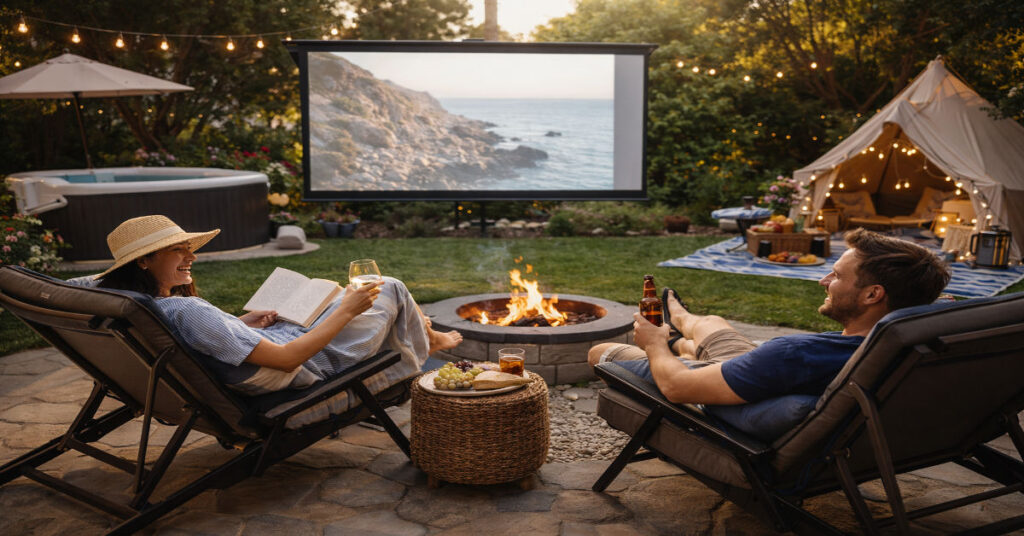
Themed movie marathon, done properly: A themed marathon — a director’s filmography, a specific decade of cinema, a country you’ve been meaning to visit — is different from passively streaming Netflix. The structure matters: pick the theme in advance, commit to watching without phones, and treat it as an event. The physical arrangement of your space contributes: pull curtains, get good snacks, use a projector if you have one. The theming creates a sense of cultural journey that randomly browsing does not.
Learn one new thing with your hands: A morning spent learning to make pasta from scratch, throwing clay on a beginner wheel, or attempting a botanical illustration is a different cognitive mode than entertainment consumption. Skill acquisition — even at a clumsy beginner level — produces a state of flow that psychologist Mihaly Csikszentmihalyi identified as one of the most reliable sources of subjective satisfaction. The low-stakes, no-stakes nature of doing it purely for yourself during a staycation removes performance anxiety.
Backyard or balcony camping: This sounds trivial but consistently over-delivers. The act of sleeping outside — even five metres from your kitchen — changes the sensory texture of the experience enough to produce genuine novelty. Night sounds, outdoor temperature, the mild inconvenience of not having immediate access to the fridge: these small disruptions activate the same noticing-mode as travel. With children, it is reliably memorable. Without them, it remains a surprisingly effective context shift.
The intentional slow day: One underrated staycation idea: nothing. A single day with no planned activities, no digital consumption, and no agenda beyond eating well and being physically comfortable. This is not laziness — it is deliberate, structured rest. The key is pre-commitment: decide in advance that the day will contain no productivity, no screen content beyond music, and no scheduled events. Make a good breakfast. Read a physical book. Walk aimlessly. The evidence suggests that unstructured time, when genuinely protected from the pull of productivity, produces deeper cognitive recovery than activity-dense schedules.
Staycation Ideas: Honest Comparison
| Activity | Cost Range | Novelty Impact | Recovery Value | Best For | Common Failure Mode |
| Local hotel night | $80–$250 | High | Very High | Anyone who can’t mentally leave home | Booking with late checkout; using phone as normal |
| City tourist day | $20–$80 | High | High | Urban residents, curious minds | Going to familiar places; no advance booking |
| Neighbourhood food tour | $40–$120 | Medium-High | Medium | Foodies, couples, groups | Revisiting the same rotation; skipping new spots |
| Hiking / outdoor day | $0–$30 | Medium | High | Nature lovers, solo rechargers | Listening to podcasts throughout; going somewhere familiar |
| Themed movie marathon | $0–$25 | Medium | Medium | Film lovers, rainy days | No theme; passive scrolling between films |
| New skill / craft day | $15–$60 | Medium-High | High | Hands-on, creative types | Choosing something too complex; abandoning when it gets hard |
| Backyard camping | $0–$40 | Medium | High | Families, novelty-seekers | Coming back inside when it gets slightly uncomfortable |
| Intentional slow day | $0 | Low | Very High | Chronic over-schedulers | Filling it; checking phone; “treating yourself” into guilt |
Staycation activity comparison across key value dimensions. Recovery value reflects cognitive and emotional restoration; novelty impact reflects psychological displacement from routine.
Planning a Three-Day Staycation: A Practical Structure
Most staycation advice treats the component activities as interchangeable. In practice, sequencing matters. Based on the psychology of recovery and novelty, a three-day structure performs better when it follows a specific arc: high novelty first, medium structure in the middle, unstructured slow day at the end.
| Day | Focus | Morning | Afternoon | Evening | Key Rule |
| Day 1 | Novelty & departure from routine | Check into local hotel OR launch tourist day | Museum, guided tour, new neighbourhood | Restaurant reservation somewhere new | No work, no social media |
| Day 2 | Active engagement | Outdoor adventure (hike, kayak, bike) | Farmers’ market or food tour | Live event, film, or skill activity | Minimal phone; one 20-min social window |
| Day 3 | Slow recovery | Late wake, good breakfast, no agenda | Walk without destination; physical book | Home-cooked meal; early rest | No screens until evening; no plans |
Recommended three-day staycation structure. Day 3’s slow day is frequently cut by people who feel guilty about “doing nothing” — this is the most common structural error.
Three Things the Standard Staycation Advice Gets Wrong
1. The “Plan Your Next Vacation” Idea Is Counterproductive
Several popular staycation idea lists suggest using the time to plan your next real vacation — organising a photo album, researching destinations, booking future trips. This advice appears well-intentioned but is neurologically backwards. Future-oriented planning activates the same prefrontal cortex regions associated with work and decision fatigue. It is cognitively indistinguishable from a mild form of work. The Staycation Ideas restorative value depends on reducing planning load, not redirecting it. Reserve trip planning for a regular Wednesday evening, not your carefully constructed recovery window.
2. “Rearranging a Room” as a Scenery Change Rarely Works
The advice to “change your scenery” by rearranging furniture or sleeping in a different room is circulated widely, including in mainstream media coverage. The underlying logic is sound — context shifts aid recovery — but the execution almost never produces sufficient psychological displacement. You are still surrounded by your possessions, your maintenance obligations, your ambient domestic noise. The context shift needs to cross a perceptual threshold to activate the novelty response. Minor spatial rearrangements typically don’t clear it. Spending even a single night in a genuinely unfamiliar space — a friend’s spare room, a budget hotel, a local Airbnb — Staycation Ideas is more effective than redecorating your bedroom.
3. Solo Staycations and Group Staycations Require Different Designs
Most Staycation Ideas guides treat the social dimension as incidental. In reality, solo and group staycations have structurally different failure modes and require different designs. Solo staycations are more vulnerable to reversion to productivity (without social accountability, the laptop reappears). Group staycations — with partners, families, or friends — are more vulnerable to coordination overhead becoming stressful in itself. Solo designs should include more structured external commitments (booked tickets, reservations, tours) that function as accountability. Group designs need fewer activities, more buffer time, and explicit permission for individuals to break off and have solo hours. The mistake most group staycations make is applying a travel-density schedule to a domestic environment where the logistical overhead is zero — the result is that everyone ends up bored or irritable by day two.
The Future of Staycation Ideas in 2027
Several Staycation Ideas structural forces are converging to make staycations not just a budget alternative to travel, but a culturally distinct category with its own infrastructure and expectations.
First, the hospitality industry is actively investing in “local guest” products. Major hotel chains began restructuring weekend packages for local residents during 2020–2021 out of necessity. By 2025, the category had matured: hotels in urban markets now explicitly market to residents within a 30-kilometre radius, with amenity bundles (spa access, late checkout, dining credits) designed around someone who has no logistical need to be there but has chosen to be. This trend will deepen by 2027 as hotels discover that local guests book more spontaneously, tip higher on food and beverage, and are more likely to return than destination travellers.
Second, the experience economy around local discovery is expanding. City walking tour operators, food experience platforms, and urban adventure companies saw significant post-pandemic growth as residents became more conscious of the cultural density in their own cities. By 2027, most mid-sized cities in Europe, North America, and urban Asia will have a richer menu of structured local experiences than existed in 2019.
Third, and perhaps most structurally significant: remote and hybrid work has permanently blurred the home-work context boundary. The psychological challenge of staycations — maintaining detachment from work in a space that functions as an office — is getting harder for a large portion of the workforce, not easier. This will increase demand for the “external anchor” model: staycations built around at least one night outside the home, not because the accommodation is superior, but because it is necessary for genuine detachment. The hotel industry and short-term rental platforms are well-positioned to serve this, but only if they price for residents rather than visitors.
What will not change: the fundamental mechanics of cognitive recovery. Novelty, boundary-setting, physical movement, and reduced decision load will remain the active ingredients in 2027 for the same neurological reasons they are now.
Key Takeaways
- Psychological detachment from work — not physical distance — is the primary driver of staycation recovery; boundaries must be structural, not willpower-dependent.
- Booking even one local hotel night is the highest-impact single move for people who genuinely struggle to mentally leave home, functioning as a commitment device enforced by the environment itself.
- The highest-satisfaction staycations combine structured outside-the-home novelty with at least one genuinely unscheduled, screen-minimal day — the second half is what most people skip, and it’s the most restorative.
- Planning your next vacation during a staycation is counterproductive: future-oriented planning activates the same cognitive load as work, undermining recovery.
- Solo and group staycations have distinct failure modes; solo designs benefit from external accountability anchors (tickets, reservations), while group designs need explicit buffer time and permission for solitude.
- The “rearrange a room” scenery-change advice rarely crosses the perceptual threshold needed to activate the brain’s novelty response; a single night in a genuinely unfamiliar space is far more effective.
- By 2027, urban hospitality and local experience infrastructure will be substantially richer; the structural challenge of staycations will be psychological detachment in an era of remote work, not activity scarcity.
Conclusion
The best staycation isn’t the one with the most activities on the itinerary. It’s the one where you’ve genuinely negotiated with your own cognitive defaults — the pull toward productivity, the ambient anxiety of unread messages, the domestic guilt that reframes rest as laziness — and won. That negotiation is harder than booking a flight. Travel provides the enforcement automatically: you’re on a plane, your email barely loads, the environment is unfamiliar. The staycation requires you to construct those conditions yourself.
But that’s also the argument for taking it seriously Staycation Ideas. Done well, a staycation teaches you something about what you actually need to recover — and that knowledge is portable to every future vacation, every weekend, every evening. The city you live in almost certainly contains more than you’ve experienced of it. Your own home, stripped of its obligations for two or three days, contains more comfort and creative possibility than it gets credit for. The constraint is rarely the location. Staycation Ideas almost always the architecture of the break itself. Build that correctly, and the destination becomes incidental.
Frequently Asked Questions
What’s the single most important thing to do before starting a staycation?
Set hard digital boundaries: turn off work notifications, set an out-of-office message, and either delete social apps temporarily or use screen time controls to limit access. Research shows that merely anticipating a work message produces stress equivalent to actually receiving one — structural disconnection outperforms willpower every time.
Is it worth spending money on a local hotel for a staycation?
For people who struggle to mentally disengage at home, yes — it is probably the highest-ROI staycation expense available. The psychological value is context shift and commitment device, not room quality. A modest hotel with a late checkout and pool access outperforms a luxury room you leave at 11am.
How do I avoid a staycation feeling like a wasted weekend?
Sequence deliberately: start with high-novelty outside-the-home activity, build toward a structured middle day, and end with an intentional slow day with no agenda. Avoid filling every hour. The unscheduled slow day at the end is the element most likely to be cut — and the most restorative.
What are the best free staycation ideas?
A long hike or bike ride somewhere unfamiliar, a tourist day at a free local museum or cultural landmark, backyard camping, a themed home film marathon with a strict no-phone rule, and a slow intentional day with no screens or plans. None of these require significant spending; all require deliberate structure.
Do staycations actually work for stress recovery, or are they a poor substitute for real holidays?
Research on vacation recovery consistently identifies psychological detachment — not distance — as the active ingredient. A staycation with strong boundaries and structured novelty produces measurable stress reduction. A poorly structured international trip does not. The staycation is not inherently inferior; it is structurally harder to execute, which is a different problem.
What staycation ideas work best with children?
Backyard camping, city tourist days targeting interactive museums or science centres, cooking a new cuisine together, and a themed film marathon with age-appropriate picks all perform well. The key difference from adult staycations: children benefit more from physical novelty and less from unstructured slow days, so activity density should be modestly higher.
How far in advance should I plan a staycation?
At least one week for local hotel bookings (weekends in city-centre hotels fill faster than most residents expect) and popular restaurant reservations. Museum tickets, guided tours, and event tickets often require 5–10 days’ notice. The planning overhead is low compared to travel, but last-minute staycations frequently default to passive entertainment consumption.
References
- Sonnentag, S., & Fritz, C. (2007). The Recovery Experience Questionnaire: Development and validation of a measure for assessing recuperation and unwinding from work. Journal of Occupational Health Psychology, 12(3), 204–221. https://doi.org/10.1037/1076-8998.12.3.204
- de Bloom, J., Kompier, M., Geurts, S., de Weerth, C., Taris, T., & Sonnentag, S. (2009). Do we recover well from vacations? A meta-analysis of vacation effects on health and well-being. Journal of Occupational Health, 51(1), 13–25. https://doi.org/10.1539/joh.K8004
- Hunter, M. R., Gillespie, B. W., & Chen, S. Y. (2019). Urban nature experiences reduce stress in the context of daily life based on salivary biomarkers. Frontiers in Psychology, 10, 722. https://doi.org/10.3389/fpsyg.2019.00722
- Querstret, D., & Cropley, M. (2012). Exploring the relationship between work-related rumination, sleep quality, and work-related fatigue. Journal of Occupational Health Psychology, 17(3), 341–353. https://doi.org/10.1037/a0028552