
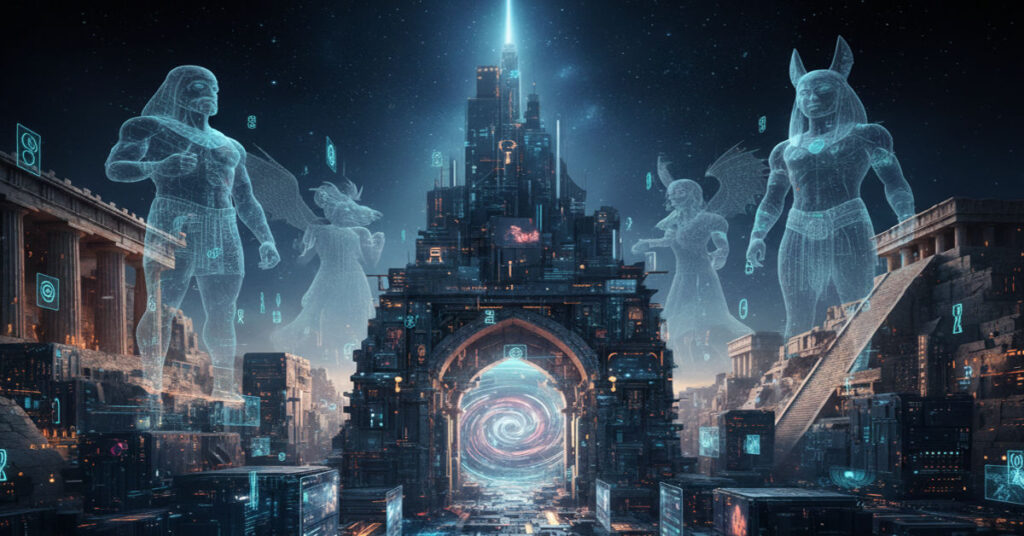

The endurance of mythology is not merely a testament to the quality of ancient storytelling, but a reflection of its role as the original social operating system. Whether we are discussing the tragic foresight of Prometheus or the weary nihilism of Gilgamesh, these stories serve as the primary mirrors for human behavior, community dynamics, and the collective psyche. In the modern era, where digital subcultures frequently repurpose these archetypes to build new “lore,” understanding the roots of these narratives becomes essential for decoding today’s cultural patterns. Mythology provides a shared vocabulary that transcends the limitations of language and geography, offering a blueprint for how we navigate the tension between individual ambition and communal responsibility.
The way a community treats its heroes—and its monsters—tells us everything we need to know about its values. When we look at the Greek pantheon, we see a reflection of a society obsessed with civic duty, excellence (arête), and the terrifying randomness of the natural world. Conversely, when we pivot to the older, more dust-laden tales of the Fertile Crescent, we encounter a human relationship with the divine that is far more transactional and anxiety-ridden. These are not just “stories” for entertainment; they were the mechanisms through which ancient people processed trauma, celebrated victory, and enforced moral codes. To study them today is to perform an autopsy on the very concept of “belonging.”
The Architect of Rebellion: Prometheus and the Cost of Innovation
The myth of Prometheus remains one of the most potent symbols of the “disruptor” archetype within our cultural lexicon. By stealing fire from the heights of Olympus to gift it to a shivering humanity, Prometheus committed the ultimate act of horizontal resource distribution—a move that Zeus, the ultimate central authority, could not let go unpunished. The consequence was not just a personal tragedy of eternal liver-pecking; it was a cosmic shift in the power dynamic between the divine and the mortal.
In my observations of modern tech-centric communities, the “Promethean” label is often claimed by those who seek to bypass traditional gatekeepers. However, the original myth carries a weight of suffering that today’s “disruptors” often ignore. Prometheus did not just innovate; he bore the systemic burden of that innovation. The fire he brought was both a tool for warmth and a weapon for war. This duality—the “gift” that necessitates a new set of ethical boundaries—is where the community must step in to regulate what the hero has unleashed.
The Labyrinth of the Self: Theseus and the Athenian Identity
If Prometheus represents the spark of intellect, Theseus represents the consolidation of civic identity. His journey into the heart of the Labyrinth to slay the Minotaur is the quintessential narrative of the “civilizer.” Athens, at the time, was a community under the thumb of Cretan hegemony, forced to pay a blood tribute that stripped it of its future. Theseus’s intervention was as much a political statement as it was a heroic feat.
The Minotaur itself—a hybrid of man and beast—symbolizes the “otherness” that settled societies fear most: the loss of human reason to animalistic impulse. By navigating the Labyrinth with Ariadne’s thread, Theseus demonstrated that the solution to complex, systemic problems is often a combination of individual bravery and external support. The thread is a perfect metaphor for the social ties that keep us from getting lost in the complexities of our own making. When Theseus returned, he didn’t just bring back his life; he brought back the sovereignty of his people, fundamentally changing the community’s standing in the Mediterranean world.
The Gorgon’s Mirror: Perseus and the Social Gaze
The tale of Perseus and Medusa is frequently reduced to a monster-slaying adventure, yet its cultural implications run much deeper, touching on the power of the “gaze” and the social consequences of beauty and curse. Medusa, originally a victim of divine jealousy and trauma, was transformed into a creature so terrifying that to look at her was to be turned to stone—a literalization of social paralysis and ostracization.
Perseus’s success depended entirely on his ability to not look directly at the problem. By using Athena’s polished shield as a mirror, he engaged with the threat through a mediated perspective. In our current digital culture, we see this reflected in how communities handle toxic figures or overwhelming social crises; often, direct engagement leads to burnout (turning to stone), whereas the “shield” of satire, art, or analytical distance allows the community to process the threat without being destroyed by it.
| Hero | Primary Tool | Cultural Value Represented |
| Prometheus | Fire | Intellectual Sovereignty & Sacrifice |
| Theseus | Ariadne’s Thread | Civic Duty & Strategic Logic |
| Perseus | Reflective Shield | Mediation & Divine Favor |
| Jason | The Argo | Collective Ambition & Teamwork |
The First Epic: Gilgamesh and the Search for Immortality
Long before the Greeks refined the hero’s journey, the Sumerians were grappling with the existential dread of mortality through the King of Uruk, Gilgamesh. This Mesopotamian epic is perhaps the most “human” of all ancient stories because it begins with a hero who is, frankly, a terrible leader. Gilgamesh is arrogant, oppressive, and disconnected from his people until the gods create Enkidu—a wild man intended to be his rival, who instead becomes his soulmate.
The loss of Enkidu triggers a pivot in the narrative from a series of “boss fights” to a profound meditation on grief. Gilgamesh’s quest for the secret of eternal life leads him to Utnapishtim, the survivor of a Great Flood that mirrors the later Biblical narrative. The realization Gilgamesh eventually reaches—that immortality is found only in the lasting walls of the city he built—is a powerful endorsement of the community as the only true vessel for a legacy. As noted mythologist Joseph Campbell once observed, “The hero is the one who has given his or her life to something bigger than oneself.” For Gilgamesh, that “something bigger” was the civilization of Uruk itself.
The Argonautica: High-Stakes Collaboration and Its Fallout
The voyage of the Argo to retrieve the Golden Fleece is mythology’s first “ensemble cast” film. Unlike Perseus or Theseus, who often worked in isolation or with minimal help, Jason assembled a “dream team” of heroes—including Heracles, Orpheus, and the twins Castor and Pollux. This story highlights the dynamics of a high-performance team under pressure, where the leader’s primary role is not just to be the strongest, but to manage the egos and specialized talents of the group.
However, the cultural takeaway of the Argonautica is often overshadowed by the figure of Medea. Her role in Jason’s success was absolute, yet her subsequent betrayal and the horrific end of their union serves as a cautionary tale about the transactional nature of power. In the eyes of the ancient Greeks, the “team” succeeded, but the “family” failed. It’s a recurring theme in digital-age startups and creator collectives: the mission may be achieved, but at a devastating cost to the interpersonal fabric that held the group together.
Divine Vanity: Andromeda and the Cost of Boasting
The story of Andromeda, chained to a rock as a sacrifice to the sea monster Cetus, is a stark reminder of how the mistakes of the powerful are often borne by the vulnerable. Her mother, Cassiopeia, committed the sin of hubris by claiming she was more beautiful than the Nereids. The sea nymphs didn’t strike Cassiopeia; they convinced Poseidon to punish the entire kingdom.
“In the ancient world, the individual was never truly an individual; they were a node in a web of familial and civic responsibility. When one node failed, the entire web felt the vibration.” — Dr. Elena Vance, Classical Historian.
This narrative of Mythology Stories collective punishment for individual vanity is one that resonates deeply within modern social media dynamics. When a “main character” in the digital space makes a catastrophic error, it is rarely just they who suffer; their “kingdom”—their followers, their brand, or their community—often bears the brunt of the backlash. Perseus’s rescue of Andromeda is the rare “happy ending” in a genre that usually prefers tragedy, but even this required the intervention of a hero who was himself an outcast from his own home.
The Bitter Contest: Poseidon, Athena, and the Patronage of Athens
One of the most revealing Mythology Stories regarding community values is the contest between Poseidon and Athena for the patronage of Athens. Each god offered a gift to the citizens: Poseidon struck the earth with his trident and produced a spring of salt water (representing naval power and trade), while Athena planted an olive tree (representing peace, sustenance, and agriculture).
The citizens chose the olive tree. This decision was a profound cultural statement: the community prioritized long-term stability and internal growth over the volatile, aggressive expansion represented by the sea.
| Deity | Gift Offered | Symbolism | Outcome |
| Poseidon | Salt Spring | Naval Might / War | Rejected |
| Athena | Olive Tree | Peace / Prosperity | Selected |
This choice defined the Athenian “brand” for centuries. Mythology Stories were to be a people of the mind and the soil, even as they eventually became a naval empire. It shows that even in the presence of gods, the community holds the power of validation.
The Eternal Punishment: Zeus’s Strategy of Deterrence
When we look back at the punishment of Prometheus, we see Zeus not as a benevolent father, but as a CEO protecting proprietary secrets. The chaining of Prometheus to Mount Caucasus was designed to be a public spectacle—a “security theater” to ensure no other Titan or god would attempt a similar redistribution of power.
This use of deterrence is a recurring theme in how societies manage dissent. By making an Mythology Stories example of the one who breaks the rules for the “greater good,” the central authority reinforces the status quo. However, as the myth progresses, we see that the community eventually views Prometheus as a martyr, not a criminal. Over time, the “risk” of the fire became the foundation of civilization, and the punishment of its bringer became a symbol of the inherent friction between progress and preservation.
Narrative Evolution: From Oral Tradition to Digital Lore
Today, we see the same patterns of myth-making in online spaces. When a community “cancels” a figure, they are performing a modern-day ostracism, much like the Greeks did to those who threatened the social order. When a subreddit creates a complex backstory for a meme, they are engaging in the same world-building that once birthed the Olympian hierarchy.
The medium Mythology Stories has changed—moving from oral epics to stone tablets, then to the printing press, and now to instant digital transmission—but the human need for archetypes remains constant. We still need the “Tricky One” (Hermes/Loki), the “Wise Mother” (Athena/Frigg), and the “Reluctant Hero.” These characters allow us to project our own anxieties and aspirations onto a stage where the stakes are cosmic, making our own daily struggles feel like part of a grander, more meaningful design.
Takeaways: The Legacy of Ancient Lore
- Social Blueprints: Myths functioned as the primary moral and social frameworks for ancient civilizations, dictating behavior and hierarchy.
- The Cost of Progress: The Prometheus narrative highlights that every major technological or social leap comes with a systemic “price” paid by the innovator.
- Civic Identity: Figures like Theseus show how mythology was used to justify political sovereignty and the “civilizing” of chaotic forces.
- The Power of the Collective: Even the greatest heroes (like Jason) were often dependent on the diverse skills of a community to succeed.
- Vanity and Backlash: The story of Andromeda warns that the actions of leaders often have disproportionate consequences for the innocent members of their community.
- Enduring Archetypes: Modern digital culture continues to use ancient mythological structures to build identity and navigate social conflict.
Conclusion
The study of Mythology Stories is, ultimately, the study of what it means to be human in a world that often feels indifferent to our survival. These stories survived not because they were “true” in a literal, historical sense, but because they are “true” in a psychological and social sense. They provide us with a map of the human heart—its capacity for incredible courage, its tendency toward self-destruction, and its yearning for a connection to something larger than the self. As we continue to build new digital “Mythology Stories” in the 21st century, we would do well to remember the lessons of the old ones: that fire must be managed, that every Labyrinth has a center, and that no hero—no matter how powerful—can survive without the thread that connects them to the rest of humanity. The stories we tell about ourselves today will be the mythology of tomorrow; we should Mythology Stories choose them with the same weight and purpose as the ancients did.
FAQs
1. Why is Greek Mythology Stories more popular than Mesopotamian mythology?
Greek mythology became the foundation of Western literature and art, particularly during the Renaissance. Because European powers dominated global education systems for centuries, Greek tales like those of Zeus and Hercules were prioritized. Mesopotamian myths, while older, were only rediscovered in the 19th century through the deciphering of cuneiform, meaning they haven’t had as much time to permeate modern popular culture.
2. Was Gilgamesh a real person?
Most historians believe Gilgamesh was likely a real king who ruled the Sumerian city-state of Uruk around 2700 BCE. Over centuries, his actual deeds were embellished with supernatural elements until he became the semi-divine figure of the epic. This process of “euhemerism”—where historical figures are transformed into gods or legendary heroes—is common in many ancient traditions.
3. What is the main difference between Greek and Norse gods?
The primary difference lies in their mortality. Greek gods are truly immortal and generally untouchable by time or death. In contrast, Norse gods (like Odin and Thor) are “fated” to die during Ragnarök. This gives Norse mythology a more somber, fatalistic tone, reflecting the harsh environment and warrior culture of the Scandinavian peoples.
4. Why did Poseidon lose the contest for Athens?
Poseidon lost because his gift, though powerful, was impractical. A salt-water spring provided no sustenance and symbolized the volatile, often destructive nature of the sea. Athena’s olive tree provided food, oil, and wood, symbolizing a stable, agrarian-based economy. The myth reflects the Athenian value of “civilized” wisdom over “raw” elemental power.
5. Is the Golden Fleece a real object?
In a literal sense, no. However, historians suggest it may refer to an ancient method of mining gold. People in the Caucasus region would place sheepskins in fast-moving streams to trap gold flakes. After a time, the fleece would be “golden.” Jason’s quest might be a mythologized memory of early Greek trade expeditions seeking these gold-rich territories.
References
- Black, J., & Green, A. (1992). Gods, Demons and Symbols of Ancient Mesopotamia: An Illustrated Dictionary. British Museum Press.
- Burkert, W. (1985). Greek Religion: Archaic and Classical. Harvard University Press.
- Campbell, J. (1949). The Hero with a Thousand Faces. Pantheon Books.
- Dalley, S. (2000). Myths from Mesopotamia: Creation, the Flood, Gilgamesh, and Others. Oxford University Press.
- Gantz, T. (1993). Early Greek Myth: A Guide to Literary and Artistic Sources. Johns Hopkins University Press.
- Graves, R. (1955). The Greek Myths. Penguin Books.