
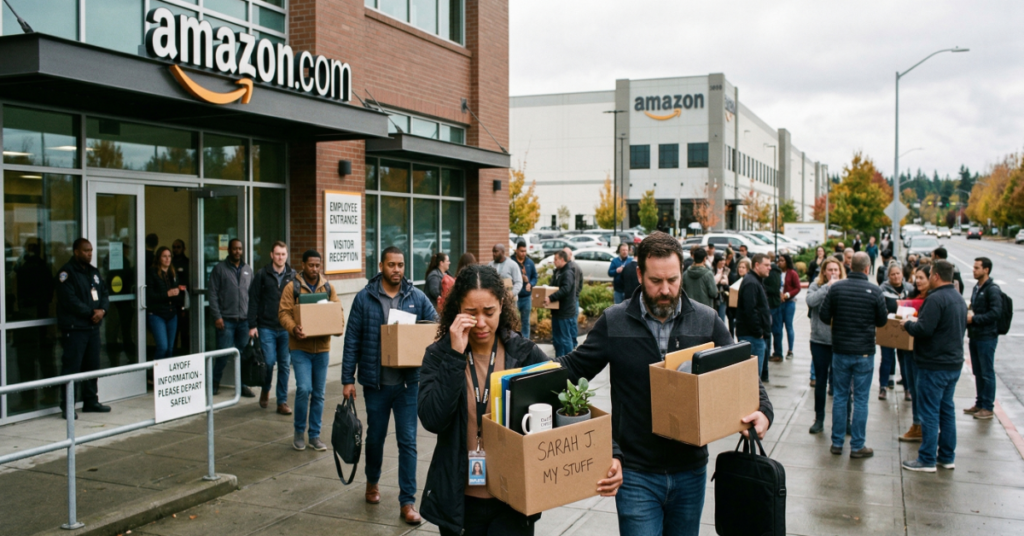

In late January 2026, Amazon confirmed the elimination of approximately 16,000 corporate roles — a round that leaked early when an internal calendar invite was accidentally sent to a wider distribution list than intended. The notification, which named the restructuring “Project Dawn,” quickly spread across internal Slack channels as badge access was deactivated and security personnel began escorting employees from offices in Seattle, Bellevue and international hubs including the UK and India.
This wasn’t a surprise to those tracking Amazon’s trajectory. The January cuts followed 14,000 role eliminations announced in October 2025, bringing total corporate reductions to approximately 30,000 positions — around 10% of Amazon’s roughly 350,000-person white-collar workforce. CEO Andy Jassy had telegraphed the logic in prior communications: fewer managers, less bureaucracy, more individual ownership, and an expanding reliance on AI tooling to absorb workloads that previously required headcount.
Amazon’s Form 10-K for fiscal year 2025 disclosed approximately $2.7 billion in estimated severance and related costs tied to planned role eliminations — a figure covering only costs booked through year-end, meaning total restructuring costs are likely to rise significantly once the January 2026 wave is captured.
For AI developers, enterprise technology decision-makers, and product leaders, Amazon’s restructuring isn’t background noise. It is a live, at-scale signal about where AI replaces coordination overhead, which organizational layers are structurally redundant in an automated enterprise, and how the most profitable companies in cloud and e-commerce are reconfiguring the ratio of human capital to AI capability. This connects directly to broader trends we’ve analyzed at Nanobanana, including how AI tools are reshaping enterprise productivity benchmarks.
Which Departments Were Hit — and Why
AWS, HR, and the Functions Built Around Human Coordination
Amazon Web Services, Prime Video, People Experience and Technology (HR), and retail operations face the heaviest cuts. Program management, support roles, and administrative positions are particularly vulnerable as Amazon implements AI automation. Engineering roles focused on AI and machine learning and core infrastructure appear comparatively safer than operational support positions.
The targeting logic is not arbitrary. HR and program management are roles built around coordination: onboarding, compliance tracking, benefits administration, vendor oversight, and workflow orchestration. These are precisely the functions that large language models and enterprise AI agents have become capable of handling — not in theory, but in production.
Department Impact by Function
| Department | Impact Level | Primary Reason |
| HR & Recruiting | High | Automation of onboarding, compliance, benefits admin |
| Operations Management | High | AI-driven logistics optimization and decision routing |
| AWS Support Roles | Medium-High | Self-service infrastructure tools and agent-based support |
| Prime Video & Content | Medium | Generative AI adoption in content ops and scheduling |
| Program Management | High | Coordination layer compressed by AI workflow tools |
| Experimental Units | High | Cost rationalization of non-core initiatives |
| AI/ML Engineering | Low | Strategic investment area — protected from cuts |
Source: WARN Act filings, internal communications, Reuters/AP reporting
Washington State as a Data Point
WARN Act filings submitted to Washington state labor authorities show 2,198 affected jobs in Washington alone, with separations beginning April 28, 2026, and extending into June — consistent with Amazon’s stated 90-day internal job-search window. The staggered schedule suggests Amazon is managing departures in cohorts rather than executing a single mass termination event, which matters for enterprise continuity planning and severance cost recognition across quarters.
Severance Architecture: What Affected Employees Actually Receive
Amazon is offering most US-based employees 90 days to look for a new role internally, followed by transition support including severance pay, outplacement services, and health insurance benefits for those unable to find or not pursuing a new role.
Internal communications provided practical instructions to affected employees: staff must return company laptops using provided shipping boxes after their separation date, with personal item collection surveys due by February 13.
The 90-day internal mobility window is consequential, but competitive. Amazon is eliminating roles while simultaneously continuing hiring in strategic functions — meaning laid-off employees are competing for a narrowing set of openings against both internal transfers and external candidates.
Tech Industry Severance Benchmarks (2023–2026)
| Company | Severance Base | Per Year Served | Extras |
| Amazon (2026) | Multiple months (tenure-based) | Yes | Outplacement, COBRA |
| Meta (2023) | 16 weeks | +2 weeks/year | Retained bonus |
| Google (2023) | 16 weeks | +2 weeks/year | Cash performance bonus |
| Microsoft (2023) | 60-day notice | Additional severance | Role-dependent |
| Block (2026) | Disclosed internally | Not public | AI transition cited |
Source: Company announcements, Reuters, Bloomberg, Challenger Gray & Christmas
For senior employees — particularly those at L6 and above with tenure exceeding five years — severance agreements are typically negotiable, with common negotiation points including additional severance weeks, extended health insurance coverage, accelerated 401(k) vesting, and outplacement services. Employees generally have 21 days to review and sign.
AI as a Labor Compression Engine: Real Mechanism or Investor Narrative?
This is where the analysis requires precision. Amazon, like other large technology companies announcing layoffs in 2026, has cited AI efficiency as a structural driver. The question worth interrogating is whether AI is genuinely replacing headcount or whether workforce reduction is being explained through an AI frame that serves investor relations more than operational reality.
The evidence points to both being true simultaneously — and that distinction matters for enterprise planning.
What AI Is Actually Compressing
Amazon’s workforce reduction is tied to a ten-year, $100 billion investment in artificial intelligence technologies, with funding redirected from job eliminations to support enhancements to AI infrastructure including data centers, machine learning models, and AI-powered products.
AI now handles demand forecasting, inventory allocation, customer service automation, code generation and debugging, and internal reporting and analytics. This reduces the need for coordinators, analysts, entry-level engineers, and administrative oversight roles — which map almost exactly to the departments hit hardest.
In divisions like AWS, entire departments are reportedly being consolidated, with small clusters of senior engineers using advanced AI models to manage workloads that previously required dozens of employees.
Three Hidden Risks Most Analyses Miss
1. Knowledge extraction risk. Outgoing staff members have described ‘knowledge transfer sessions’ where they were encouraged to meticulously document their decision-making processes and creative workflows — processes that sources claim were fed into training datasets to refine AI agents. This is standard practice for organizations building domain-specific AI agents, and it represents a genuine labor relations exposure that will likely surface in future regulatory discussions around AI training data consent.
2. The severance cost paradox. Amazon spent $2.7 billion on severance in 2025 alone. That is a substantial upfront investment for efficiency gains that will take 18–36 months to materialize as operational savings. The bet is rational if AI tooling eliminates those headcount costs permanently — but it fails if AI augmentation still requires significant human oversight at scale, which is the current reality in regulated and high-stakes operational contexts.
3. The 90-day competitive intelligence window. Employees searching for internal roles over 90 days while simultaneously notified of elimination have every incentive to externalize knowledge, build external network capital, and leave with institutional context that competitors can benefit from. Amazon’s structure doesn’t prevent this — it creates the conditions for it.
These dynamics connect to the broader question of how AI investment strategies are reshaping platform economics — a topic we’ve also examined in our analysis of AI-powered stock platforms and their accuracy claims.
Comparative Context: Amazon vs. the 2026 Tech Layoff Landscape
The tech industry reported 33,330 layoffs in the first two months of 2026 — a 51% increase from the year-earlier period, according to outplacement firm Challenger, Gray & Christmas. Artificial intelligence was cited in 12,304 U.S. job cuts announced between January and February — 8% of total layoffs during that period.
Major Tech Layoffs: 2025–2026 Comparative View
| Company | 2025–2026 Cuts | AI Cited | Primary Target | Structure |
| Amazon | ~30,000 | Yes | AWS, HR, retail ops, PM | Core ops compression |
| Meta | ~6,500 | Partial | Low performers + restructuring | Talent filtering |
| ~12,000 | Yes | AI realignment | Talent redeployment | |
| Microsoft | ~10,000 | Yes | Cloud optimization | AI integration |
| Block | ~1,000+ | Explicit | Operations, support | Margin optimization |
| Citigroup | 1,000+ | No | Finance/operations | Cost reduction |
Source: Challenger Gray & Christmas, Layoffs.fyi, company announcements
Amazon’s cuts are structurally different from Meta’s or Citigroup’s in one important respect: they are concentrated in AI-adjacent infrastructure and coordination roles — signaling that the company isn’t just removing underperformers, it is restructuring the organizational model itself. Block’s announcement may be one of the clearest parallel examples: a profitable company explicitly tying large-scale layoffs to AI-enabled productivity, setting a benchmark that boards across industries are now examining.
Strategic Implications for Enterprise Decision-Makers
1. AI Adoption Will Reshape Workforce Planning
Organizations should expect reduced need for mid-level coordination roles, increased demand for AI system operators, and hybrid human-AI workflows that require new performance measurement frameworks. Traditional KPIs built around headcount efficiency will evolve toward output per compute unit, automation coverage, and decision latency reduction.
2. Talent Strategy Must Adapt
Enterprises will need fewer generalists and more AI-literate specialists. The displacement pattern visible at Amazon — where program managers and HR coordinators are eliminated before engineers — will repeat across sectors where coordination overhead is high relative to strategic output. This is relevant context for anyone building enterprise technology infrastructure, including the database optimization and scalability decisions that underpin AI deployment at scale.
3. Institutional Memory Is a Competitive Asset
Block’s CFO Leadership Council noted it plainly: ‘AI can automate workflows, but it doesn’t replace the experience of employees who understand clients, controls, and historical decisions. Cut too deep and you may improve short-term margins while increasing long-term operational risk.’ Amazon’s $2.7 billion severance spend is visible. The cost of lost institutional knowledge is not — and that asymmetry is where the real strategic risk lives.
Methodology
This analysis draws on Amazon’s January 28, 2026 official statement published on aboutamazon.com; the company’s fiscal year 2025 Form 10-K SEC filing disclosing $2.7 billion in severance costs; Washington state WARN Act filings showing job separation timelines extending into June 2026; Challenger, Gray & Christmas outplacement firm reporting on 2026 tech layoff volumes and AI attribution rates; and cross-referenced reporting from Reuters, AP, Bloomberg, and CNBC on Project Dawn scope and internal communications.
Limitations: Amazon has not publicly released a department-level breakdown of either layoff round, requiring inference from WARN filings, regulatory records, and employee accounts on platforms including Blind. Projections for Q2 2026 are based on unconfirmed internal reporting and should be treated as plausible but unverified.
Are More Amazon Layoffs Coming?
Documents circulating within Amazon’s upper management reportedly point toward an additional 14,000 job cuts slated for the second quarter of 2026, driven by a new efficiency framework that prioritizes AI-augmented productivity over traditional headcount. This has not been independently confirmed by Amazon, and should be treated as an unverified but plausible extension of the current restructuring trajectory.
Amazon itself acknowledged the question in its January 2026 communication: some employees asked whether this is the beginning of a new rhythm of broad reductions every few months. The company did not deny the premise. What it described was a model in which continued hiring in strategic areas coexists with ongoing role eliminations in functions being absorbed by automation.
Discussions among current Amazon employees on professional forums suggest the consumer division and additional AWS teams remain at risk, with estimates ranging from 7,000 to 10,000 additional roles, though Amazon leadership has been reluctant to execute a single large reduction.
The Future of Amazon’s Workforce Model in 2027
By 2027, Amazon’s restructuring will have resolved into one of two outcomes — or a hybrid of both.
Scenario A: Validated efficiency. AWS and retail operations achieve measurable productivity gains from AI-augmented teams. Smaller, senior-heavy engineering clusters manage services that previously required proportionally larger headcount. This validates the model for the broader enterprise market, accelerating similar restructuring across Fortune 500 HR, legal, and operations functions.
Scenario B: Operational debt accumulates. Institutional knowledge loss, AI system brittleness in edge cases, and the coordination gap left by eliminated program managers create compounding reliability issues — not visible in quarterly earnings but surfacing as customer-facing service degradation, compliance failures, or engineering velocity slowdowns.
The regulatory dimension adds complexity. Senator Lisa Blunt Rochester has introduced legislation (S. 3319) requiring the Departments of Labor, Commerce, and Education to jointly report on AI’s employment impact with workforce preparation recommendations. If this advances, companies like Amazon will face disclosure requirements about AI’s role in workforce decisions — changing the transparency calculus for future rounds.
The most structurally significant 2027 development to watch: whether Amazon’s model of aggressive AI-driven headcount reduction, combined with continued investment in foundation model infrastructure, becomes a replicable enterprise template — or a cautionary case study in over-rotation away from human capital. The answer will shape how enterprise technology decision-makers approach workforce planning far beyond the tech sector.
Key Takeaways
- Amazon has eliminated approximately 30,000 corporate roles across two rounds (October 2025 and January 2026), targeting AWS, HR, Prime Video, and retail operations.
- The internal codename is Project Dawn; affected US employees receive 90 days to seek internal roles before severance, outplacement services, and health benefits apply.
- Amazon recorded $2.7 billion in severance-related costs in fiscal year 2025 — with January 2026 costs not yet captured.
- AI efficiency is both the stated rationale and the active replacement mechanism, but institutional memory and knowledge-extraction risks are real, underreported exposures.
- Severance packages are negotiable, particularly for senior employees, within a 21-day review window.
- A potential second phase of up to 14,000 additional cuts in Q2 2026 has been reported but not confirmed by Amazon.
- Tech sector AI-attributed layoffs are accelerating: 12,304 U.S. cuts in January–February 2026 alone cited AI as a driver.
Conclusion
Amazon Layoffs 2025–2026 restructuring is significant not because of its scale alone — 30,000 cuts against a 1.57 million-person total workforce is less than 2% of headcount — but because of what it signals about the organizational logic of AI-era enterprise. The targeted elimination of coordination and management layers, funded by a $100 billion AI investment commitment, represents a deliberate architectural bet: that AI can absorb the connective tissue of corporate operations without degrading the reliability of the systems that tissue supports.
The $2.7 billion severance bill makes clear this is not a reactive cost-cut but a proactive restructuring — expensive in the near term, rationalized against long-term overhead reduction. Whether that bet holds depends on how well Amazon’s AI tooling performs in production environments where edge cases, regulatory requirements, and customer trust are not forgiving of model degradation or knowledge gaps.
For enterprise decision-makers watching from outside, the operative question isn’t whether to follow Amazon’s model. It’s whether your organization’s AI tooling is mature enough to absorb the coordination workload you’re considering eliminating — and whether the institutional memory required for operational resilience has been adequately preserved before it walks out the door.
Frequently Asked Questions
How many people did Amazon lay off in total?
Amazon eliminated approximately 30,000 corporate roles across two rounds: roughly 14,000 in October 2025 and 16,000 in January 2026. Warehouse and logistics employees were not affected. The cuts represent about 10% of Amazon’s approximately 350,000-person corporate workforce.
What is Project Dawn?
Project Dawn is Amazon’s internal name for the January 2026 restructuring that eliminated 16,000 corporate positions. It follows a prior wave of cuts in October 2025 and is part of CEO Andy Jassy’s stated effort to reduce management layers, streamline operations, and align organizational structure with AI-driven workflows.
Which Amazon departments were hit hardest?
Amazon Web Services, Human Resources (People Experience and Technology), Prime Video, and retail operations faced the heaviest cuts. Program managers, mid-level managers, and administrative support roles were disproportionately affected. Core AI/ML engineering and infrastructure roles were comparatively protected.
What severance do laid-off Amazon employees receive?
US-based employees receive approximately 90 days to find an internal role before separation. Those who do not secure a new position receive severance pay scaled to tenure, outplacement services, and continued health insurance benefits. Senior employees typically have 21 days to negotiate the initial severance offer.
Are more Amazon layoffs expected in 2026?
Reports Amazon Layoffs citing internal documents suggest a potential additional phase of up to 14,000 cuts in Q2 2026, focused on the consumer division and parts of AWS. Amazon has not confirmed this. The company acknowledged in January 2026 communications that the current restructuring is not necessarily a one-time event.
How do Amazon’s layoffs compare to other tech companies?
Amazon Layoffs combined 30,000 cuts are among the largest in the current cycle. The broader tech sector reported 33,330 layoffs in January–February 2026 alone — a 51% increase year-over-year. Amazon’s targeting of coordination and management roles is structurally distinctive compared to Meta’s performance-based cuts or Citigroup’s finance reductions.
Is AI actually replacing Amazon workers or is it a narrative cover?
Both elements are present. Amazon is genuinely deploying AI to absorb routine coordination, HR administration, and workflow orchestration tasks previously requiring dedicated headcount. The $100 billion AI investment commitment and SEC-disclosed severance costs provide verifiable evidence that the structural shift is real, even if the full operational impact remains to be demonstrated by Amazon Layoffs.
References
Amazon Layoffs. (2026, January 28). Corporate restructuring announcement. https://www.aboutamazon.com/news/company-news/amazon-layoffs-corporate-jan-2026
Amazon. (2026). Form 10-K: Annual report for fiscal year ended December 31, 2025. U.S. Securities and Exchange Commission. https://www.sec.gov
Challenger, Gray & Christmas. (2026, March). Amazon Layoffs report: January–February 2026. https://www.challengergray.com
Washington State Employment Security Department. (2026). WARN Act notices: Amazon.com Inc. https://esd.wa.gov
Reuters. (2026, January 22). Amazon plans thousands more corporate job cuts next week. https://www.reuters.com
Associated Press. (2026, January 28). Amazon cuts 16,000 corporate jobs in second round of layoffs. https://apnews.com
Layoffs.fyi. (2026). Tech layoff tracker: 2022–2026. https://layoffs.fyi
CFO Dive. (2026, March). Block, Amazon drive tech layoff surge, intensifying AI debate. https://www.cfodive.com/news/ai-linked-over-12000-us-job-cuts-year-challenger-amazon-block/814271/
U.S. Senate. (2026). S. 3319: AI workforce impact reporting act (introduced by Sen. L.B. Rochester). https://www.congress.gov