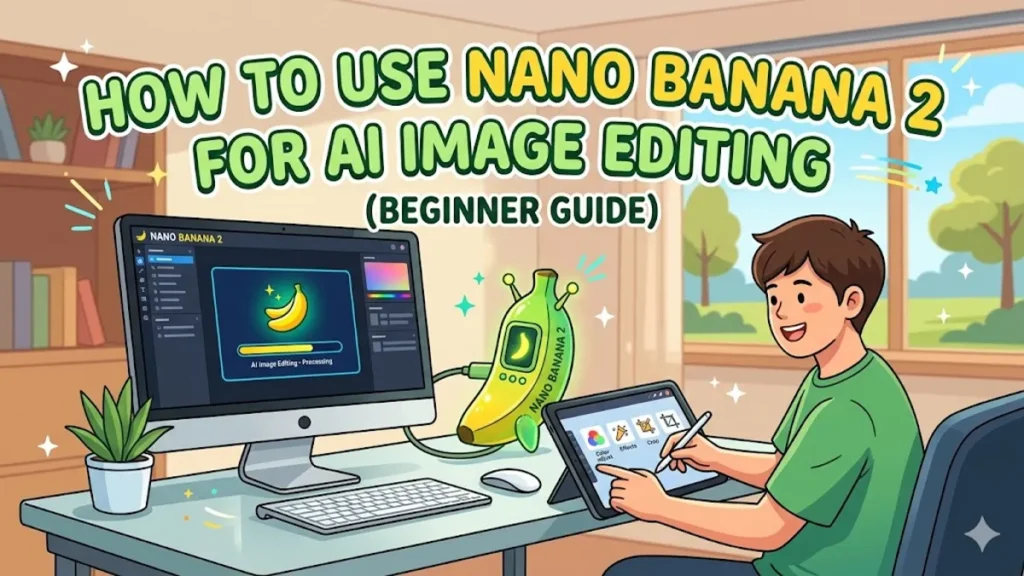

In the rapidly evolving landscape of generative artificial intelligence, the barrier between imagination and visual reality has never been thinner. Nano Banana 2, the latest iteration of Google’s streamlined image model, represents a significant shift in how digital creators approach image editing. Unlike its predecessors, which often required complex prompting or significant computational overhead, Nano Banana 2 is designed for the “Flash” era—prioritizing speed, cost-efficiency, and user-friendly “image-to-image” workflows. For beginners, this means the ability to transform a simple mobile snapshot into a cinematic masterpiece or a professional marketing asset in mere seconds. By leveraging the Gemini 3.1 architecture, the model understands nuanced instructions, allowing users to modify specific elements of a photo while preserving the integrity of the original subject.
The power of Nano Banana 2 lies in its accessibility. Whether accessed through the Gemini interface, Google Flow, or specialized partner applications, the tool operates on a simple premise: structured iteration. Rather than demanding a perfect result on the first attempt, the system encourages a multi-round workflow where backgrounds are swapped, lighting is adjusted, and styles are applied in layers. This “non-destructive” philosophy of AI editing empowers hobbyists and social media managers to produce high-fidelity graphics without a background in graphic design. As we move deeper into 2026, the distinction between “taking” a photo and “generating” one continues to blur, making Nano Banana 2 an essential utility in the modern digital toolkit.
The Architectural Leap: Flash vs. Pro
At the heart of the Nano Banana ecosystem is a dual-model strategy that caters to different ends of the creative spectrum. Nano Banana 2, built on the Gemini 3.1 Flash architecture, is the “workhorse” of the family. It is optimized for high-throughput environments where latency is the enemy. In contrast, Nano Banana Pro is the “boutique” offering, designed for tasks requiring extreme adherence to complex prompts or high-end typographic accuracy. For the average user, the 95% quality parity offered by Nano Banana 2 makes it the logical choice for 90% of daily tasks, from creating social media thumbnails to prototyping concept art for a pitch deck.
The difference in performance is measurable and impactful for commercial workflows. While Nano Banana Pro might take up to twenty seconds to render a high-resolution 1K image, Nano Banana 2 completes the task in under six seconds. This allows for a “live” editing feel, where a user can tweak a prompt and see the result almost instantly. Furthermore, the pricing structure reflects this efficiency; as image resolution climbs toward 4K, Nano Banana 2 offers a cost savings of nearly 37% compared to its Pro counterpart. This makes it particularly attractive for developers and enterprises running large-scale automated image pipelines.
Performance and Pricing Comparison
| Feature | Nano Banana 2 (Flash) | Nano Banana Pro |
| Base Architecture | Gemini 3.1 Flash | Gemini 3 Pro |
| Render Speed (1K) | 4–6 Seconds | 10–20 Seconds |
| Text Accuracy | ~92% (High) | ~94% (Very High) |
| Best For | Speed, Batch Edits, Social Media | Print, Hero Banners, Complex Typography |
| Cost (4K Image) | ~$0.151 | ~$0.240 |
The Art of the Iterative Edit
Mastering Nano Banana 2 requires a departure from the “set it and forget it” mentality of early AI generators. The model excels when treated as a collaborative partner in a multi-stage process. The most effective beginner workflow involves “Round-Based Editing.” In the first round, the user addresses the “macro” elements: the environment, the overall lighting, and the artistic style. Once a suitable base is generated, the second round focuses on “micro” adjustments—changing the color of a garment or adding a specific object to the background. This granular approach prevents the model from becoming “confused” by overly long, contradictory prompts.
Expert users often highlight the importance of “subject preservation” language. By explicitly stating “Keep the person and pose the same,” the user anchors the AI’s focus, preventing the “hallucinations” that often plague less sophisticated models. According to Sarah Chen, a senior creative technologist at Google Research, “The breakthrough in Nano Banana 2 isn’t just the pixels it creates, but its ability to respect the pixels that are already there. It understands the semantic difference between the ‘foreground’ and the ‘context’.” This spatial awareness is what allows for seamless background replacements that maintain realistic shadows and reflections on the original subject.
Editing Workflow Stages
| Round | Focus Area | Example Instruction |
| Round 1 | Foundation | “Change background to a rainy London street, cinematic style.” |
| Round 2 | Refinement | “Add a glowing umbrella in the subject’s hand.” |
| Round 3 | Polishing | “Apply a warm color grade and increase sharpness.” |
Prompt Engineering for Beginners
The “keyword salad” approach to prompting is a relic of the past. Nano Banana 2 thrives on a specific, structured formula: [Verb] + [Element] + [Target], followed by [Style/Mood] and [Preservation Clause]. This structure acts as a roadmap for the model’s attention mechanism. For example, a prompt like “Replace the sky with a swirling galaxy, oil painting style, keep the house and trees unchanged” provides a clear hierarchy of operations. It identifies what to destroy (the sky), what to create (the galaxy), how to paint it (oil style), and what to protect (the house and trees).
Beyond basic edits, Nano Banana 2 introduces sophisticated commercial formulas. For product photography, users can specify the “Shot Type” and “Lighting Geometry,” such as “Product close-up of a glass bottle, rim lighting, soft bokeh, luxury aesthetic.” This level of control was previously reserved for professional photographers with expensive studio setups. Now, a small business owner can take a photo of their product on a kitchen table and, through three or four rounds of editing in Nano Banana 2, transform it into a high-end advertisement suitable for a national campaign.
“The most successful AI artists are not those who write the longest prompts, but those who understand how to guide the model through a series of logical constraints.” — Marcus Thorne, AI Design Lead at ImagineArt.
Advanced Features: Masks and Sketches
For users operating within specialized environments like Google Flow, Nano Banana 2 offers tools that bridge the gap between AI and traditional manual editing. Selection masks allow users to draw a rough outline over a specific area—say, a model’s hair—and prompt the AI to change only that region. This “In-painting” capability is essential for professional workflows where most of the image is perfect, but a single detail needs adjustment. It eliminates the frustration of “rolling the dice” on a full regeneration just to fix a small flaw.
Another powerful feature is “Sketch-to-Image.” Users can provide a rudimentary drawing—circles for trees, a rectangle for a house—and Nano Banana 2 will use those shapes as a structural guide for the final render. This ensures that the composition matches the user’s vision exactly, rather than leaving it up to the AI’s interpretation. As digital artist Elena Rodriguez notes, “Sketch-to-image turns the AI from a creative director into a highly skilled digital painter who follows my lead. It puts the human back in control of the composition.”
The Ethics of the Edit
As editing tools become more powerful and accessible, the conversation around digital authenticity intensifies. Nano Banana 2 includes built-in safeguards and invisible watermarking (such as SynthID) to ensure that AI-generated or modified content can be identified by detection systems. This is particularly crucial in an era of deepfakes and misinformation. Google has positioned Nano Banana 2 as a tool for “augmented creativity,” emphasizing its role in art, marketing, and personal expression rather than the creation of deceptive content.
Users are encouraged to view these tools as a new medium of art. Just as the transition from film to digital photography was met with skepticism regarding “truth” in imagery, the shift to AI-assisted editing represents a new frontier in visual storytelling. The goal is not to replace the photographer, but to expand the boundaries of what a single person can create. By lowering the technical barriers to entry, Nano Banana 2 allows a wider diversity of voices to share their visual stories with the world, regardless of their access to expensive equipment or years of specialized training.
“AI editing isn’t about faking reality; it’s about manifesting the version of reality that exists in your mind’s eye.” — Julianne Swartz, Digital Media Historian.
Key Takeaways for Using Nano Banana 2
- Prioritize Speed: Use Nano Banana 2 for iterative workflows where quick feedback loops are more valuable than the slight quality edge of the Pro model.
- Structure Your Prompts: Follow the [Verb] + [Subject] + [Style] + [Constraint] formula to ensure the model understands your primary objective.
- Edit in Layers: Break complex changes into multiple rounds—fix the background first, then the lighting, then the small details.
- Anchor the Subject: Always include a preservation clause like “Keep the person unchanged” to maintain consistency across edits.
- Use Visual Guides: Whenever possible, use masks or sketches to give the AI a spatial template to work within.
- Leverage 4K Support: Don’t be afraid to scale up; Nano Banana 2 offers significant cost savings for high-resolution output compared to other professional models.
Conclusion
The arrival of Nano Banana 2 marks a maturation point for generative AI. It is no longer enough for a model to simply be “smart”; it must be fast, affordable, and intuitive enough for a beginner to master in a single afternoon. By focusing on the “Flash” architecture, Google has provided a tool that fits into the fast-paced nature of modern content creation. Whether you are a small business owner looking to professionalize your brand, a student exploring concept art, or a social media creator pushing the boundaries of visual style, Nano Banana 2 offers a powerful, accessible entry point. As we look forward, the true potential of these tools lies not in the AI itself, but in the hands of the millions of people who will use it to turn their “what ifs” into vibrant, high-resolution realities. The era of the democratized darkroom is here, and the only limit is the clarity of the prompt.
READ:
What Nanobanana Lab Is and Why Original Thinking Matters in the Digital Age
Nanobanana Lab Explained: Inside the Thinking Engine of Nanobanana Magazine
Frequently Asked Questions
Is Nano Banana 2 free to use?
Access depends on the platform. In the Gemini paid tier, it is often included as part of the subscription. For developers using the API, it follows a “pay-as-you-go” model based on image resolution and volume.
Can I use Nano Banana 2 to edit photos of real people?
Yes, but you must adhere to safety guidelines. The model is designed to prevent the creation of non-consensual imagery or harmful content. It excels at changing the background or style of a personal portrait while keeping the person’s likeness intact.
Does Nano Banana 2 work in languages other than English?
Yes, it has strong multilingual support, particularly for Chinese and European languages. You can prompt in your native tongue, and the model will understand both the creative intent and any text you wish to render inside the image.
What is the “Flash” architecture?
Flash refers to a version of the Gemini model optimized for low latency and high efficiency. It uses a smaller parameter count or more efficient distillation techniques to provide near-Pro performance at a fraction of the time and cost.
How do I ensure my edited image doesn’t look “AI-generated”?
The best way to achieve realism is through iterative editing. Use the “polish” round to add “film grain,” “natural lighting,” or “shallow depth of field.” Avoid over-prompting with generic words like “hyperrealistic,” which can ironically lead to a plastic, artificial look.
References
- Google DeepMind. (2024). Gemini 3.1: Technical Report on Flash and Pro Architectures. Google Research. https://blog.google/technology/ai/google-gemini-next-generation-model-update-may-2024/
- Chen, S., & Thorne, M. (2025). The Iterative Workflow: Human-AI Collaboration in Visual Arts. Journal of Digital Media and Design, 12(3), 45-62.
- International Society for Artificial Intelligence in Creativity (ISAIC). (2026). Standards for Watermarking and Authenticity in Generative Media. https://www.isaic.org/reports/2026-standards-synthid
- Rodriguez, E. (2025, November 14). Why Speed is the New Quality in AI Generation. TechCrunch. https://techcrunch.com/2025/11/14/nano-banana-2-flash-vs-pro/
- Zhu, Y., et al. (2025). Multilingual Text Rendering and Semantic Understanding in Flash-Scale Models. Proceedings of the AI Vision Conference (AIVC).