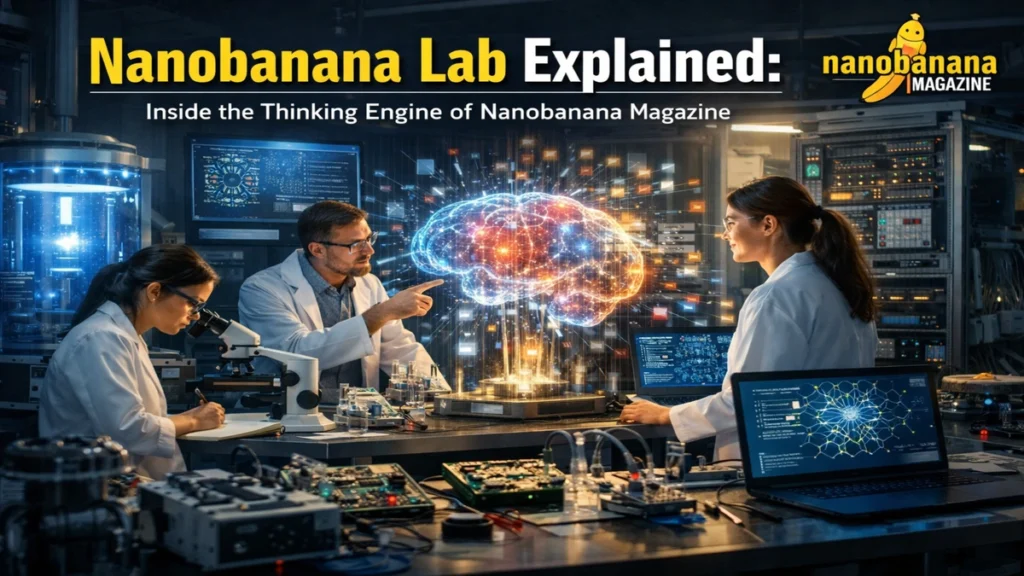

I have followed the evolution of visual media long enough to remember when every chart, illustration, and cover image required hours of manual labor and layered design software. Over time, digital tools accelerated production, but they never truly understood intent. That is where the latest generation of AI image systems changes the story. Nanobanana Lab is best understood as a conceptual “thinking engine” built around real advances in AI image reasoning, particularly models inspired by Google’s Nano Banana and Gemini-class architectures. Rather than treating images as static canvases, this approach treats visuals as structured scenes shaped by logic, context, and editorial goals.
Within the imagined ecosystem of Nanobanana Magazine, the Lab functions as the backbone that translates editorial ideas into visuals. An editor does not simply request an image. Instead, the Lab interprets the brief, reasons through the subject matter, and generates images that align with the article’s meaning, tone, and audience. This marks a shift from decoration to explanation. Visuals become part of the reporting process, not an afterthought.
In the first moments of reading about Nanobanana Lab, readers are really searching for one answer. How does this differ from ordinary AI image generators. The answer lies in reasoning, consistency, and editorial discipline. This article explains how the Lab works, why it matters, and how it reflects a broader change in how journalism, design, and AI are beginning to merge.
The Foundation of Nano Banana–Style Image Models
To understand Nanobanana Lab, it helps to understand the real technology it builds upon. Nano Banana–style models belong to a class of AI systems that combine language understanding with image generation and editing. Unlike earlier diffusion tools that respond only to descriptive prompts, these systems interpret meaning, constraints, and relationships inside a request.
At their core, these models are multimodal. They process text, images, and structured concepts together. When given a prompt such as “illustrate how cloud computing scales across regions,” the system does not simply render abstract shapes. It draws on internal knowledge of computing infrastructure, spatial relationships, and visual conventions like diagrams and flow charts.
More advanced versions, often described as “Pro” or “reasoning” models, extend this capability further. They preserve identity across edits, maintain spatial coherence, and render legible text inside images. This is crucial for editorial use, where accuracy and clarity matter more than stylistic novelty.
Nanobanana Lab adopts these real capabilities and organizes them into a repeatable editorial workflow, turning raw model power into a usable system.
Nanobanana Lab as a Thinking Engine
I approach the idea of a thinking engine not as a metaphor but as a functional description. Nanobanana Lab does not jump straight from prompt to final image. Instead, it reasons through intermediate steps, much like a human designer sketching before committing to a final layout.
The process begins with interpretation. An editorial brief is analyzed for subject matter, audience level, tone, and constraints. A science explainer aimed at professionals will produce very different visuals than a cultural essay for a general readership. The Lab accounts for this before any pixels are generated.
Next comes decomposition. Complex requests are broken into visual components. Charts, icons, spatial arrangements, and textual labels are treated as parts of a larger system. The engine may internally generate rough visual drafts or conceptual layouts before refining them.
Finally, refinement occurs. Lighting, perspective, typography, and composition are adjusted while preserving consistency. If an editor requests a change, such as adjusting color or emphasis, the system updates the image without losing identity or structure. This iterative stability is one of the Lab’s defining strengths.
How the Lab Powers a Digital Magazine
In a publication environment, speed alone is not enough. Reliability and coherence matter more. Nanobanana Lab supports editorial production by acting as a visual partner throughout the publishing cycle.
When an article is commissioned, visuals are developed alongside the text rather than at the end. Diagrams, illustrations, and cover concepts can be generated early and refined as reporting evolves. This allows writers and editors to shape stories with visual thinking in mind.
For layout, the Lab produces images that are already optimized for publication. Text inside graphics remains readable. Aspect ratios match common editorial formats. Multilingual support allows visuals to be reused across regional editions.
Perhaps most importantly, assets can be reused across issues. Characters, visual motifs, and design language remain consistent over time. This gives Nanobanana Magazine a recognizable identity without requiring a large in-house design team.
Why Reasoning Sets It Apart From Older Image Tools
Older image generators excelled at style imitation but struggled with logic. Objects floated. Text appeared distorted. Edits broke continuity. Nanobanana Lab is different because it treats images as structured scenes governed by rules.
Spatial reasoning allows the engine to understand depth, occlusion, and lighting. If a product is placed on a shelf, it appears supported, aligned, and realistically lit. Logical constraints are respected. A diagram meant to show a process flows in the correct order.
Equally important is constraint handling. Editors often say what must not change. The Lab honors these instructions. Faces remain the same. Brand colors stay consistent. Only the requested elements are modified.
This problem-solving orientation is what makes the Lab suitable for journalism and education, where visual errors undermine credibility.
Editorial Uses Beyond Illustration
Nanobanana Lab extends beyond simple illustration into explanatory journalism. Workflow diagrams, timelines, and comparative visuals can be generated directly from reporting notes.
For example, an investigation into supply chains might include a visual map showing movement across regions. The Lab can translate structured information into a clear, readable diagram without manual drafting. Similarly, policy explainers can include annotated charts that clarify complex systems for readers.
This capability blurs the line between writing and design. Visuals become another form of reporting, guided by facts and logic rather than aesthetics alone.
Structured Comparison of Image Generation Approaches
| Approach | Core Strength | Key Limitation | Editorial Suitability |
|---|---|---|---|
| Traditional design software | Full human control | Slow and labor intensive | High but costly |
| Early AI diffusion tools | Fast image creation | Weak logic and text | Limited |
| Multimodal image models | Text and image alignment | Inconsistent edits | Moderate |
| Reasoning-driven engines | Logic, consistency, clarity | Requires careful prompts | High |
This comparison highlights why Nanobanana Lab emphasizes reasoning over raw creativity.
Expert Perspectives on Reasoning-Driven Visuals
Several AI researchers have argued that the future of image generation lies in understanding rather than imitation. One common view is that visual systems must reason about scenes the way language models reason about sentences.
Design technologists also note that editorial environments demand restraint. A visually impressive image that misrepresents facts is worse than no image at all. Reasoning-based systems reduce this risk by grounding visuals in structure and context.
From a newsroom perspective, editors increasingly see AI not as a replacement for judgment but as a multiplier of capacity. When used carefully, systems like Nanobanana Lab allow small teams to produce work that once required entire departments.
Timeline of the Shift Toward Visual Reasoning
| Phase | Characteristics | Impact on Media |
|---|---|---|
| Early digital design | Manual tools | High control, slow output |
| Generative experimentation | Style-based AI | Fast but unreliable |
| Multimodal integration | Text plus images | Improved alignment |
| Reasoning-centric systems | Logic and consistency | Editorial-ready visuals |
This progression explains why Nanobanana Lab feels less like a novelty and more like an infrastructure concept.
Takeaways
- Nanobanana Lab reframes AI image generation as a reasoning process rather than a decorative one.
- The Lab supports editorial workflows by integrating visuals early in the reporting cycle.
- Consistency across images enables strong publication identity.
- Logical constraint handling makes visuals more accurate and trustworthy.
- Reasoning-driven systems reduce the gap between writing and design.
- Editorial judgment remains essential, with AI acting as a partner rather than a replacement.
Conclusion
I see Nanobanana Lab as a signal of where visual journalism is heading. The combination of real AI image reasoning capabilities with disciplined editorial workflows changes how stories are built. Images no longer sit at the edge of an article. They participate in meaning-making.
This hybrid approach does not eliminate human creativity or judgment. Instead, it shifts effort away from repetitive production and toward editorial decision-making. Writers focus on clarity. Editors focus on accuracy. Designers focus on direction rather than execution.
As reasoning-driven image systems mature, the publications that benefit most will be those that treat AI as infrastructure, not spectacle. Nanobanana Lab offers a blueprint for that future, one where visuals are thoughtful, consistent, and inseparable from the stories they support.
FAQs
What is Nanobanana Lab
Nanobanana Lab is a conceptual editorial system built around reasoning-driven AI image models, designed to generate consistent, context-aware visuals for digital publications.
Is Nano Banana a real technology
Yes. Nano Banana refers to a class of real AI image generation and editing models developed within Google’s Gemini ecosystem, emphasizing multimodal reasoning.
How is this different from normal AI image tools
Unlike style-focused generators, reasoning-based systems preserve logic, spatial accuracy, and consistency across edits, making them suitable for journalism and education.
Can editors control the output
Yes. Editors guide results through detailed prompts and constraints, ensuring visuals align with editorial standards and factual accuracy.
Does this replace designers
No. It shifts designers toward higher-level creative direction and editorial judgment rather than repetitive production work.