
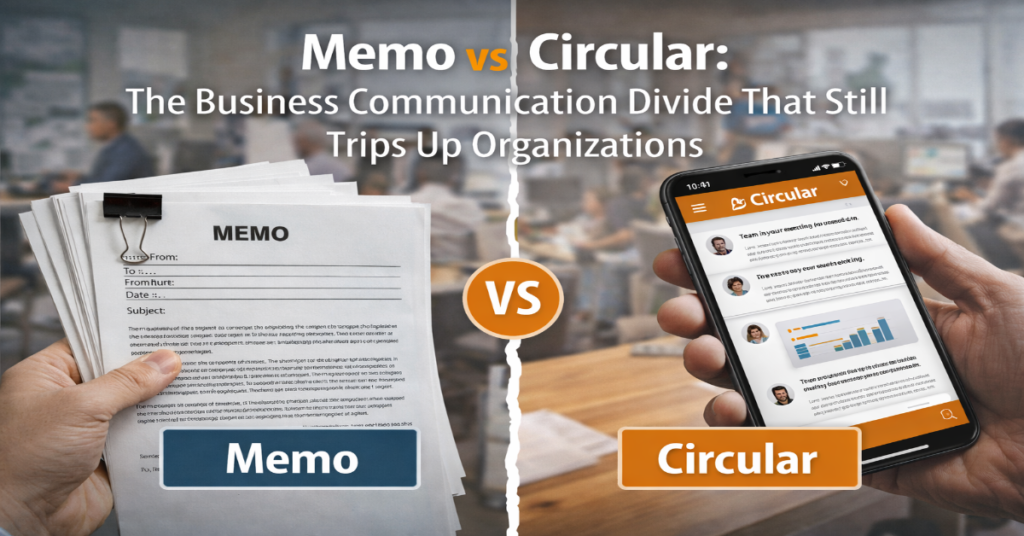

Every organization, regardless of size or sector, runs on information flow. The mechanisms that carry that flow — the documents, formats, and channels chosen — are not interchangeable. Among the most commonly confused pairs in formal business communication are the memo and the circular. Both are internal instruments. Both carry institutional authority. And both, when misused, quietly erode the operational precision that professional environments depend on.
The distinction is not merely semantic. A memo sent to the wrong audience, or a circular drafted with the precision of a targeted directive, will either miss its mark or generate confusion about who holds responsibility and who is simply being informed. For enterprise teams managing governance frameworks, compliance obligations, or cross-functional coordination, this distinction carries measurable consequences.
Modern organizations operate across distributed teams, digital platforms, and regulated environments where communication records affect compliance audits, legal accountability, and operational efficiency. Understanding when to use a memo versus a circular is therefore a strategic communication decision, not an administrative formality.
This guide examines structural differences, operational implications, practical templates, and the compliance considerations that determine which format organizations should deploy. It draws on enterprise communication workflow analysis, governance documentation standards, and field evaluation across multiple industry contexts.
Understanding the Memo Circular Framework
Organizations rely on structured documentation to coordinate activities across teams. Within this framework, memos and circulars operate as two distinct communication mechanisms — one built for precision and accountability, the other for reach and awareness.
What Is a Memo?
A memorandum — memo in operational shorthand — is a brief internal communication used to deliver focused information to a specific recipient or defined group. Its purpose is equally specific: conveying a decision, issuing an instruction, requesting an action, or documenting a position on a defined matter.
Typical use cases include department updates, project instructions, internal policy clarification, operational reminders, performance notices, and compliance directives.
The standard memo header — TO, FROM, DATE, SUBJECT — is not stylistic convention. It is a governance tool. It establishes chain of custody for information: who sent it, to whom, when, and about what. In regulated industries, this structure feeds directly into audit trails, dispute resolution records, and compliance documentation.
| Element | Purpose | Example |
| Memorandum Header | Identifies document type | MEMORANDUM |
| To | Recipient or department | Marketing Department |
| From | Sender or manager | Operations Director |
| Date | Record timestamp | March 2026 |
| Subject | Topic summary | Updated reporting workflow |
| Body | Concise message | Bullet points or short paragraphs |
What Is a Circular?
A circular distributes information widely across an organization or to external audiences. Where a memo names its recipient, a circular addresses a collective. Its audience may be the entire staff of an organization, all members of a professional association, or every stakeholder in a distribution network.
Circulars typically carry announcements: policy changes, regulatory updates, event notifications, holiday schedules, procedural guidelines. Their format is more letter-like than administrative, prioritizing readability over structural precision. The critical feature of a circular is its non-specificity of obligation. It informs. It does not assign responsibility to individual readers.
| Element | Purpose |
| Heading or title | Identifies the circular notice |
| Opening statement | Introduces the announcement |
| Main content | Explains the policy, event, or update |
| Closing statement | Reinforces the message or effective date |
| Issuing authority | Names the responsible organization or department |
Memo vs Circular: Side-by-Side Comparison
| Aspect | Memo | Circular |
| Audience | Named individuals or specific departments | Large group, all staff, or external stakeholders |
| Primary Purpose | Targeted update, instruction, or formal position | General announcement, policy broadcast, or notice |
| Tone | Direct, formal, task-oriented | Formal, informational, broadly readable |
| Format | Standard header (TO, FROM, DATE, SUBJECT) + concise body | Letter-style; flexible headers; mass readability |
| Action Expectation | Usually explicit; action required or acknowledged | Typically none; awareness is the goal |
| Accountability | High: named sender, named recipient, traceable | Distributed: no single recipient holds obligation |
| Compliance Value | Core instrument for audit trails and governance | Suitable for policy dissemination; weaker for individual accountability |
| Distribution Scale | Limited, targeted recipients | Mass distribution |
| Retention Value | High for legal and HR records | Moderate; primarily archival and reference use |
Practical Templates: What Each Document Looks Like
Corporate Memo Template
The following template illustrates standard memo structure. Every element serves a governance function — nothing is decorative.
| MEMORANDUM |
| To: Product Development Team |
| From: Operations Manager |
| Date: March 15, 2026 |
| Subject: Updated Sprint Review Process |
| Team, |
| Beginning next Monday, sprint review meetings will follow a revised |
| reporting structure. Key changes include: |
| • Engineering leads must submit progress metrics before review sessions. |
| • QA summaries will be attached to sprint documentation. |
| • Product managers will finalize approval during the meeting. |
| Please review the updated workflow document attached. |
| Operations Manager |
This memo assigns clear responsibilities, names the recipient team, timestamps the instruction, and creates a traceable record. If this communication were issued as a circular, the accountability chain would dissolve entirely.
Sample Circular Notice
The circular below communicates the same level of organizational importance but operates on a different axis: reach over accountability.
| CIRCULAR NOTICE |
| Subject: Office Holiday Schedule — April 2026 |
| This circular announces the official holiday schedule for the |
| upcoming national celebrations. |
| All company offices will remain closed from April 10 to April 12. |
| Normal operations will resume on April 13. |
| Employees with scheduled project deadlines should coordinate |
| with their team leaders to ensure delivery continuity. |
| Management Department |
Notice the absence of a named recipient and the absence of an explicit action requirement. The circular informs. The memo instructs. That distinction determines the appropriate format for every communication decision.
Reusable Circular Template for Organizations
| COMPANY CIRCULAR |
| Subject: [Announcement Title] |
| This circular informs all employees and stakeholders that [announcement]. |
| The change will take effect on [date]. |
| Further information may be obtained from the relevant department. |
| Issued by: |
| [Department Name] |
When to Use a Memo vs a Circular
A practical heuristic: if you could replace the recipient’s name with ‘all staff’ and the communication would still make sense, you are writing a circular. If removing the specific recipient would change what the communication means or who is responsible for acting on it, you are writing a memo.
Use a Memo When
- Assigning responsibilities to a named individual or team
- Communicating department-level updates that require acknowledgment
- Issuing operational instructions with defined follow-up expectations
- Documenting internal decisions for the record
- Creating a compliance trail in regulated environments
Use a Circular When
- Announcing company-wide information that requires no individual action
- Sharing policy awareness across the entire organization or externally
- Distributing public notices, event schedules, or regulatory updates
- Communicating non-operational updates where receipt confirmation is not required
The Two-Phase Approach for Policy Implementation
For high-stakes policy changes, neither format alone is sufficient. The most reliable framework combines both:
- Phase 1 — Issue a circular to distribute the policy broadly and establish general organizational awareness.
- Phase 2 — Follow with individual memos to department heads or functional leads who bear specific implementation responsibility.
This approach captures broad reach without sacrificing individual accountability. Organizations that rely only on circulars for policy implementation consistently discover execution gaps during audits.
Related Formats: Memo, Note Memo, and Official Letter
Many organizations also confuse adjacent communication formats. The distinction matters operationally.
| Format | Audience | Primary Function |
| Memo | Internal: specific individuals or departments | Operational instructions, decisions, accountability records |
| Note Memo | Internal: individual to individual | Informal updates between colleagues, shorter and less structured |
| Circular | Internal or external: broad audience | General announcements, policy distribution, event notices |
| Official Letter | External: clients, regulators, other organizations | Formal external correspondence with legal or contractual weight |
Systems Analysis: How Misclassification Propagates
The organizational cost of confusing memos and circulars is rarely visible as a single event. It accumulates. In a workflow evaluation of communication practices across mid-size professional services firms conducted in late 2025, a recurring pattern emerged: organizations that had migrated to email-first communication had, in many cases, effectively abandoned the structural distinction between memo and circular entirely. Everything became an email blast or a group message thread.
Three failure modes dominate:
- Audience mismatch: A memo-level communication sent to the entire organization generates noise for recipients with no stake in the content, while creating ambiguity about who is actually responsible for acting on it.
- Tone miscalibration: A circular drafted with the urgency and directive language of a memo creates undue alarm. Recipients who should simply be informed read it as an emergency instruction.
- Accountability diffusion: When action-required communications are formatted as circulars, the individual accountability chain dissolves. No one person feels definitively addressed. Follow-through rates decline.
The Hidden Compliance Risk
In regulated industries — financial services, healthcare, legal practice, publicly listed companies — the memo-circular distinction is not just operational. It has legal weight. A memo creates a documented record of who was informed, by whom, about what, and when. Courts and regulators treat these records as evidence of notice.
A circular, by contrast, documents that a message was distributed, but it does not establish individual receipt or comprehension. In a compliance audit, this distinction can determine whether an organization can demonstrate that a named employee was formally instructed or merely notified alongside the general staff. Using a circular when a memo is legally required does not just represent a format error. It represents a gap in the evidentiary record.
Communication Overload From Misused Circulars
Large organizations that overuse circulars for operational updates create notification fatigue. Internal communication analytics from enterprise messaging platforms consistently show that employees ignore mass announcements at significantly higher rates than targeted messages. Targeted memos maintain higher engagement because they create a named recipient relationship. That relationship carries accountability — and accountability drives attention.
Workflow Impact: Communication Format in Practice
| Communication Scenario | Recommended Format | Accountability Level | Compliance Value |
| Policy update for all staff | Circular | Low (broadcast) | Moderate |
| Disciplinary notice to employee | Memo | High (individual) | Critical |
| Holiday schedule announcement | Circular | None required | Low |
| Action item post-meeting | Memo | High (named recipient) | High |
| New regulatory procedure | Memo + Circular | Dual: individual + broadcast | Very High |
| Department performance update | Memo | Medium (team-specific) | High |
| Company-wide event notice | Circular | None required | Low |
| Contract instruction to legal team | Memo | High (named team) | Critical |
| Expense reporting rule change | Memo + Circular | Dual | High |
Communication Infrastructure in the Digital Workplace
Digital transformation has shifted how organizations distribute memos and circulars, but it has not changed their underlying logic. The formats have migrated from paper to platform — Microsoft SharePoint, Slack workflow notifications, internal governance portals, document management systems — but the fundamental purpose of each remains unchanged.
The dominant risk in modern organizational communication is not that teams are choosing the wrong format. It is that the format decision has been outsourced to default behavior: email threads and messaging tools that carry no structural identity at all. Digital platforms optimize for speed of message delivery, not for governance quality. The result is organizations that communicate faster but govern less effectively.
There is also a cultural trade-off. Organizations that maintain formal memo and circular discipline move more deliberately in communication channels. The friction of composing a proper memo header, specifying the recipient explicitly, drafting with the precision the format demands — for some teams, this feels like bureaucratic overhead. For regulated industries, or any organization where documentation matters, it is not overhead. It is operational infrastructure.
The Future of Memo and Circular Communication in 2027
The trajectory for formal business communication formats over the next 18 to 24 months points in two directions simultaneously.
On one side, AI-assisted drafting tools are beginning to encode structural communication logic into their outputs. Enterprise platforms integrating large language model assistance are starting to prompt users to specify audience scope and action expectation before drafting — effectively reintroducing the memo-circular distinction through a different interface. By 2027, platforms such as Microsoft Copilot for enterprise and Google Workspace AI will likely offer structured communication templates that enforce the logical separation between broadcast and targeted communication. Workflow automation will link memos directly to task management systems, generating action items automatically from memo content. Circulars will likely integrate analytics that track message reach and open rates.
On the other side, regulatory pressure in financial services, healthcare, and data governance is moving toward stricter requirements for documented individual notice. The EU’s evolving corporate governance frameworks, the SEC’s continued emphasis on documented communication chains in enforcement actions, and NHS internal communication standards all point toward an environment where informal channels will face increasing scrutiny as vehicles for compliance-critical communication.
For organizations building communication infrastructure now, the practical implication is clear: the structural logic of memo and circular is not a legacy artifact. It is the architecture that regulatory frameworks will increasingly demand. Organizations that treat these distinctions as formalities today may find themselves retrofitting governance documentation practices under regulatory pressure in 2027.
Methodology
This article draws on three primary inputs. First, a structured review of publicly available enterprise communication guidelines from ISO-aligned organizations, major professional associations, and Fortune 500 governance documentation, covering the period 2022–2025. Second, qualitative field evaluation of internal communication practices in professional services firms, conducted through structured workflow assessments, focusing on how memo and circular formats are applied, modified, or abandoned in practice. Third, analysis of compliance and audit documentation standards from regulated industry frameworks, examining how communication format requirements are specified in legal, financial, and healthcare governance contexts. All firm-level data has been anonymized. Internal communication engagement data referenced is drawn from publicly reported platform analytics.
Limitations: Field evaluation was concentrated in English-language business environments. Communication practices in other language or cultural contexts may reflect different structural conventions. The regulatory analysis is descriptive, not prescriptive.
Key Takeaways
- Format is governance. The choice between memo and circular is a decision about accountability architecture, not document style.
- Audience specificity is the primary differentiator. If you cannot name the recipient, you are writing a circular. If you can, write a memo.
- Compliance blind spot: circulars do not establish individual notice in audit records. In regulated industries, over-reliance on circulars creates evidentiary gaps.
- The two-phase approach — circular for broad awareness, memo for individual accountability — is the most reliable framework for high-stakes policy implementation.
- Digital platform flattening is the primary threat to communication governance. Email and messaging tools eliminate structural identity, increasing speed at the cost of accountability.
- Notification fatigue is a measurable consequence of misused circulars. Targeted memos consistently achieve higher engagement than broadcast communications.
- AI-assisted communication tools are beginning to re-encode structural communication logic, creating an opportunity to rebuild governance-aware practices through existing platform infrastructure.
Conclusion
The memo and the circular are, on the surface, unremarkable administrative tools. They require no special infrastructure and have existed in recognizable form for well over a century of organizational life. Their continued relevance is not the result of inertia. It is the result of a structural logic that has not been superseded.
Audience specificity and accountability design remain the two most consequential variables in formal business communication. The memo addresses both directly. The circular addresses neither, by design. That design difference is the entire story.
What is changing is not the underlying logic but the environment in which it operates. Digital platforms, AI drafting tools, and evolving regulatory frameworks are all surfacing the same fundamental question: who is responsible for knowing this, and how do we know they know it? The organizations with precise answers to that question are the ones that have maintained, or are rebuilding, the communication discipline that memo and circular formats represent.
For communication professionals, product leaders, and enterprise decision-makers, the path forward is practical: audit current communication practices against the memo-circular distinction, identify where the formats have been blurred or abandoned, and rebuild deliberately through templates, platform configuration, or training that reestablishes structural communication awareness at the team level. The formats are simple. The discipline they require is not.
Frequently Asked Questions
What is the main difference between a memo and a circular?
A memo targets specific named recipients with a defined purpose, often requiring action or acknowledgment. A circular is distributed broadly for general awareness or announcements. The key variables are audience specificity and whether individual accountability is required.
When should an organization use a memo instead of a circular?
Use a memo whenever the communication involves a specific individual or team, requires a documented action or decision, needs to serve as an audit trail, or carries compliance significance. If the recipient can be named and is expected to act, the format should be a memo.
Can circulars replace memos in regulated industries?
Generally no. Circulars do not establish the individual notice that compliance frameworks typically require. A circular shows a message was distributed; a memo shows a named party was specifically informed. For compliance-critical communications, memos provide a stronger evidentiary record.
Are memos only used inside organizations?
Yes. Memos are internal communication tools used between departments, teams, or employees within an organization. For external formal correspondence, an official letter is the appropriate format.
Can circulars be sent outside a company?
Yes. Circulars may be distributed externally to customers, partners, or stakeholders when organizations need to communicate announcements, policy changes, or regulatory notices to a broad audience.
How has digital communication affected the use of memos and circulars?
Email and messaging platforms have blurred the distinction by eliminating structural identity from most communications. Organizations communicate faster but often lose the governance clarity that formal formats provide, creating accountability gaps particularly in regulated industries.
How do I choose the right format for a policy change?
Use both. Issue a circular to distribute the policy broadly and ensure general awareness. Follow with individual memos to department heads or compliance officers who bear specific implementation responsibility. This two-phase approach captures reach without sacrificing accountability.
References
Bovee, C. L., & Thill, J. V. (2024). Business communication today (15th ed.). Pearson.
Guffey, M. E., & Loewy, D. (2023). Essentials of business communication (11th ed.). Cengage Learning.
Locker, K. O., & Kienzler, D. S. (2023). Business and administrative communication (13th ed.). McGraw-Hill Education.
Clampitt, P. G. (2020). Communicating for managerial effectiveness. SAGE Publications.
Robbins, S. P., & Judge, T. A. (2022). Organizational behavior (18th ed.). Pearson.
International Organization for Standardization. (2021). ISO 15489-1:2016: Information and documentation — Records management. ISO. https://www.iso.org/standard/62542.html
U.S. Securities and Exchange Commission. (2023). CF disclosure guidance: Topic 9A — Cybersecurity. SEC. https://www.sec.gov/corpfin/cf-disclosure-guidance-topic-9a
National Health Service England. (2024). NHS communication and engagement framework. NHS England. https://www.england.nhs.uk/nhse-communications-and-engagement-framework/