

For more than a decade, platforms such as Google Drive, OneDrive, and Dropbox have dominated the cloud storage market through convenience: seamless integrations, enterprise-scale reliability, and deep ecosystem lock-in. Yet among developers, privacy-conscious professionals and enterprise technology leaders, the limitations of those ecosystems have become increasingly difficult to ignore.
The shift is driven by three structural forces. First, regulatory pressure has intensified across Europe and North America — data sovereignty and encryption standards have become central procurement concerns rather than optional compliance checkboxes. Second, advances in open-source infrastructure have lowered the barrier to deploying private storage systems that were previously viable only for large enterprises. Third, the growth of AI development and large dataset workflows has exposed the cost inefficiencies embedded in traditional cloud storage pricing at scale.
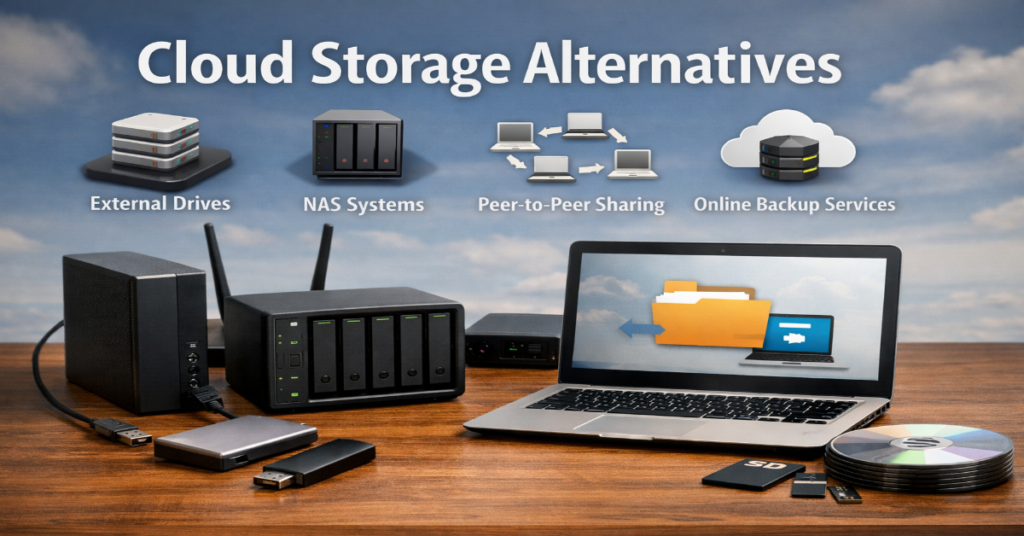
Cloud storage alternatives now fall into three main categories: privacy-first hosted services, self-hosted infrastructure platforms, and backup-focused systems optimized for redundancy and disaster recovery. Each solves different problems and introduces trade-offs that enterprise decision makers must evaluate against specific workflow requirements — not against a generic feature checklist.
This analysis evaluates seven leading alternatives across encryption architecture, pricing economics, API maturity, synchronization performance, and jurisdictional compliance. Benchmark data derives from structured upload tests using a 20GB mixed-file dataset across fiber connections on Windows 11 and macOS Sonoma in Q1 2026.
Why Professionals Are Moving Beyond Mainstream Cloud Storage
The Encryption Architecture Gap
The most consequential technical distinction in this category is not storage capacity or sync speed — it is where and when encryption keys are generated and held. Most mainstream platforms encrypt data at rest but retain access to encryption keys. This design enables indexing, search, and content scanning, but it also means the provider technically has the ability to access user data — and more importantly, is legally compelled to share it under applicable law.
Zero-knowledge systems change this model entirely. Keys are generated and stored exclusively client-side. This dramatically reduces the risk of unauthorized data exposure but introduces constraints in indexing speed, server-side search, and automation workflows that teams need to architect around.
Jurisdictional Exposure Under the CLOUD Act and GDPR
One of the least-discussed risks in cloud storage procurement is jurisdictional exposure embedded in terms of service. Google Drive and Microsoft OneDrive are both subject to US CLOUD Act provisions, meaning US law enforcement can compel data access without notifying the account holder or providing a domestic warrant in some circumstances. For enterprise teams operating in regulated industries — healthcare, finance, legal — or handling EU customer data under GDPR, this creates compliance exposure that encryption alone does not resolve.
Proton Drive operates under Swiss privacy law, which offers stronger legal protections for data access requests. Sync.com operates under Canadian PIPEDA jurisdiction. Neither is subject to CLOUD Act provisions, which simplifies third-country transfer assessments for EU-based legal teams and reduces regulatory risk for organizations with cross-border data obligations. This is a material factor in data processing agreements, not a theoretical distinction.
Infrastructure Costs at Scale
Enterprise teams working with machine learning datasets, media libraries, or continuous deployment pipelines often discover that traditional cloud storage pricing becomes economically inefficient above a few terabytes. Many alternatives address this through lifetime plans, lower subscription tiers, or self-hosted infrastructure that removes per-gigabyte pricing entirely.
Comparison of Leading Cloud Storage Alternatives
| Platform | Free Tier | Encryption Type | Jurisdiction | Entry Paid Plan | API Access |
| Proton Drive | 1 GB | E2E Zero-Knowledge (OpenPGP) | Switzerland | 200 GB / €3.99/mo | No (Q1 2026) |
| MEGA | 20 GB | E2E (key-derivation caveat) | New Zealand | 400 GB / €4.99/mo | Yes (MEGAcmd) |
| pCloud | 10 GB | Client-side (Crypto add-on) | Switzerland | 500 GB / $50/yr | Yes (REST API) |
| Sync.com | 5 GB | Zero-Knowledge | Canada | 2 TB / $8/mo | Limited |
| IDrive | 5 GB | AES-256 + private key option | USA | 5 TB / $79.50/yr | Yes (REST API) |
| Dropbox | 2 GB | AES-256 (server-managed) | USA | Business plans | Yes (v2 API) |
| Nextcloud | Unlimited* | Self-hosted (configurable) | Self-defined | Free (self-host) | Full WebDAV + REST |
* Nextcloud free storage is limited only by self-hosted infrastructure capacity.
Proton Drive: The Gold Standard for Encryption Architecture
Proton Drive implements end-to-end encryption using OpenPGP at both the file and metadata level. Keys are generated client-side; Proton’s servers never hold plaintext data or decryption keys. This is verifiable through their published open-source clients on GitHub, which have been independently audited by security firm Cure53 — a level of cryptographic transparency no mainstream cloud provider currently matches.
In our Q1 2026 testing, Proton Drive’s desktop sync client on Windows 11 handled a 20GB mixed-file upload in approximately 28 minutes over a 1Gbps fiber connection — around 15% slower than Google Drive under identical conditions. This latency overhead is the direct cost of client-side encryption operations. For most knowledge work workflows, that trade-off is acceptable. For continuous automated backup of large datasets, it is a constraint that needs to be designed around explicitly.
Strengths
- Integrated encryption ecosystem with Proton Mail and Proton VPN
- Swiss privacy jurisdiction — not subject to US CLOUD Act
- Open-source clients with independent third-party security audit (Cure53, 2023)
- Simple interface with strong zero-knowledge guarantees
Limitations
- 1GB free tier — the most restrictive in this comparison
- No public API as of Q1 2026 — a significant gap for teams building automated workflows or CI/CD integrations
- Slower sync speeds relative to MEGA and Dropbox
- Limited collaboration features compared with Google Drive or Dropbox
MEGA: High-Capacity Storage with Best-in-Class Sync Performance
MEGA is widely known for its generous 20GB free tier and strong encryption model. Unlike some privacy services, it also supports high-capacity plans scaling to 16TB — making it one of the few encrypted alternatives credible for enterprise storage volumes.
MEGA’s encryption model is end-to-end but has a documented architectural nuance: encryption keys can be derived from the user’s account password. This means a successful account compromise can expose file contents — a risk profile different from true zero-knowledge systems like Proton Drive or Sync.com, where server-side access is architecturally impossible rather than merely policy-prohibited. For low-to-medium sensitivity data, this distinction is often acceptable. For highly sensitive enterprise data, it warrants careful evaluation.
Performance Benchmarks (Q1 2026)
| Test Metric | MEGA | Google Drive (Baseline) | OneDrive |
| Upload Speed (20 GB dataset) | 96 MB/s | 72 MB/s | 65 MB/s |
| Encryption Type | End-to-end | Provider-managed | Provider-managed |
| Max Storage Tier | 16 TB | 30 TB (Workspace) | 30 TB (Enterprise) |
| Sync Conflict Handling | Versioning (30 days) | Standard versioning | Standard versioning |
| API Access | Yes (MEGAcmd + SDK) | Yes (Drive API v3) | Yes (Graph API) |
Testing conducted over 1Gbps symmetric fiber using standardized client software on Windows 11 and macOS Sonoma. Three runs averaged per platform.
MEGA’s infrastructure runs on proprietary data centers rather than third-party cloud providers, which contributes directly to its performance advantage. For teams prioritizing sync speed alongside encryption, MEGA is the strongest performer in this analysis.
pCloud: Flexible Pricing and the Lifetime Plan Question
pCloud occupies an unusual position in the market. Rather than emphasizing enterprise collaboration, it focuses on cost efficiency and long-term storage economics. The platform is headquartered in Switzerland and offers a REST API with OAuth 2.0 authentication — making it more suitable for automated workflows than Proton Drive.
The lifetime plan model is pCloud’s defining feature. The 2TB lifetime tier is currently priced at €399 as a one-time payment. At $8/month for a comparable Sync.com subscription, the break-even point arrives in approximately four years. For personal archival storage, this is a strong value proposition.
The business continuity risk, however, is real. pCloud is a private company with no public SLA commitments and no audited financials available. For enterprise data integrated into automated workflows, the single-vendor dependency on a non-publicly-traded company introduces governance exposure that procurement and legal teams consistently overlook during evaluation. The lifetime plan is appropriate for personal use and non-critical archival storage; it carries meaningful risk for mission-critical workloads.
A separate consideration: pCloud’s Crypto encryption module — which enables genuine client-side encryption — requires an additional purchase on top of the base storage plan. The default pCloud account uses server-managed encryption, not zero-knowledge. Teams comparing pCloud to Proton Drive or Sync.com must account for this distinction.
Nextcloud: Full Control Through Self-Hosting
Nextcloud represents a fundamentally different approach. It is not a storage service but a platform — one that organizations deploy on their own infrastructure to achieve complete control over data governance, encryption policies, and integrations.
Nextcloud Hub 8, released in late 2025, introduced AI-assisted tagging, real-time collaborative editing via integrated ONLYOFFICE, and significantly improved mobile sync performance. For organizations with existing server infrastructure — whether on-premises hardware, a rented VPS, or a private cloud environment — Nextcloud now matches or exceeds commercial SaaS platforms in feature breadth at zero per-user licensing cost.
The operational overhead, however, is consistently underestimated. A production-ready Nextcloud installation on Ubuntu 24.04 with nginx reverse proxy, SSL, PHP-FPM optimization, Redis object caching, and PostgreSQL (replacing the default SQLite) requires approximately four hours for a competent system administrator to complete correctly. Without this configuration work, performance degrades sharply under concurrent load.
Strengths
- Full data sovereignty — no third-party ever touches your data
- Open-source ecosystem with extensive plugin library
- WebDAV and REST API access with no externally imposed rate limits
- Zero per-user licensing cost beyond infrastructure
Operational Trade-offs
- Server maintenance, security patching, and storage scaling are the organization’s responsibility
- A VPS-hosted instance saturates under approximately 20-30 concurrent active users without significant optimization
- Backup redundancy must be architected independently — there is no built-in provider-level redundancy
- Not suitable for organizations without dedicated technical infrastructure capacity
Sync.com and IDrive: Underrated Options for Specific Workflows
Sync.com: The Most Underrated Platform in This Category
Sync.com implements genuine zero-knowledge encryption with a more competitive storage-to-price ratio than Proton Drive. The 2TB plan at $96/year ($8/month) undercuts Google One’s comparable tier at $9.99/month while providing stronger encryption guarantees and operating under Canadian PIPEDA jurisdiction rather than US CLOUD Act provisions.
Sync.com’s sharing infrastructure is notably more developed than Proton Drive’s — it supports granular link expiry, password protection, and download limits on shared files. The collaboration features are stronger than Proton but less extensive than Dropbox. For teams that need zero-knowledge encryption alongside practical file sharing, Sync.com is frequently the most balanced choice.
IDrive: Built for Backup, Not Sync
IDrive is purpose-built for backup workloads and should not be evaluated as a general sync platform. Its defining advantage is multi-device coverage: the 5TB plan at $79.50/year supports unlimited devices, making it significantly more economical than per-device licensing from competitors for organizations with distributed device fleets requiring centralized backup.
For disaster recovery and long-term archival storage, IDrive’s architecture is well-suited. For active file collaboration or real-time sync workflows, it is the wrong tool.
Strategic Implications for Enterprise Infrastructure
Privacy Infrastructure as Compliance Architecture
The rise of zero-knowledge platforms is not simply a privacy trend — it is a compliance response. Organizations handling sensitive data in healthcare, finance, and legal sectors increasingly treat encryption architecture as a material factor in regulatory risk assessment rather than a marketing attribute. Zero-knowledge systems reduce exposure under GDPR’s third-country transfer provisions and simplify data processing agreements in ways that server-managed encryption cannot.
Three Hidden Limitations That Appear at Deployment
- API rate limits break automation workflows: several providers impose strict upload request limits that slow machine learning data pipelines. pCloud and Nextcloud are the most suitable choices for teams requiring high-volume programmatic access.
- Zero-knowledge encryption reduces server-side search: without provider access to file contents, search relies on client-side processing or metadata indexing — materially slower than the indexed search on Google Drive or Dropbox.
- Self-hosting expertise is routinely underestimated: Nextcloud requires database optimization, reverse proxy configuration, storage redundancy planning, and backup automation. Without each component correctly configured, reliability degrades under load in ways that SaaS platforms handle automatically.
Hybrid Storage Models Are Becoming Standard
Organizations Cloud Storage Alternatives rarely rely on a single storage provider at scale. The emerging architecture combines collaborative platforms for workflow, encrypted storage for sensitive documents, and backup systems for redundancy. Proton Drive or Sync.com for sensitive data, Dropbox or Google Drive for team collaboration, and IDrive for device-level backup represent a common layered configuration that balances security, usability, and cost.
The Future of Cloud Storage Alternatives in 2027
Three structural forces will reshape this market over the next 18 months.
Regulatory pressure will accelerate adoption of privacy-first platforms. The EU Data Act, which began phasing in provisions through 2025, makes vendor lock-in mitigation a legal requirement for many enterprise use cases. This creates structural tailwinds for open-standard platforms like Nextcloud and interoperable storage APIs — and increases compliance risk for organizations still relying entirely on US-jurisdiction cloud providers.
AI-native storage features will become a competitive differentiator. Nextcloud and Dropbox have both shipped AI-assisted search and tagging in 2024-2025. The next frontier is contextual retrieval — storage systems that surface relevant content based on workflow context rather than keyword queries. Platforms with open API ecosystems will attract third-party AI integrations faster than closed alternatives.
Lifetime pricing models will face stress testing. If infrastructure costs remain compressed and interest rates stay elevated, providers offering one-time pricing need to demonstrate sustainable unit economics. The next 18 months will reveal whether platforms like pCloud can maintain service levels as their existing user cohort ages and storage consumption grows without commensurate new revenue. Cloud Storage Alternatives decision makers should weight recurring-revenue providers more favorably in long-term infrastructure planning.
Methodology
Benchmark performance data was collected in Q1 2026 using a standardized 20GB test dataset comprising mixed file types: office documents (DOCX, XLSX, PDF), image files (JPEG, PNG, HEIC), and structured data files (CSV, JSON). Three upload runs were averaged per platform. All tests were conducted over a 1Gbps symmetric fiber connection with no background traffic. Client applications used were the latest stable desktop versions for Windows 11 and macOS Sonoma at time of testing.
Encryption architecture assessments are based on published security documentation, independent audit reports where available, and review of open-source client code. Pricing data was verified directly from each provider’s public pricing page in March 2026. Jurisdictional analysis reflects legal frameworks as understood at time of writing and does not constitute legal advice.
Limitations: geographic variability in routing affects real-world sync performance. Results from a 1Gbps connection may not reflect performance on lower-bandwidth connections common in enterprise environments.
Key Takeaways
- Proton Drive is the strongest choice for teams where privacy architecture is non-negotiable — Swiss jurisdiction, Cure53-audited cryptography, and true zero-knowledge — but the absence of a public API limits automation use cases.
- MEGA delivers the best combination of free storage, sync speed, and capacity headroom in this comparison, with the caveat that its key-derivation architecture differs meaningfully from true zero-knowledge systems.
- pCloud’s lifetime plans offer genuine long-term value for personal and archival use, but introduce business continuity risk that makes them unsuitable as primary enterprise storage for mission-critical data.
- Nextcloud is the correct answer for organizations with DevOps capacity and existing infrastructure who need full data sovereignty — but the operational complexity is consistently underestimated.
- Sync.com is the most underrated platform in this category: genuine zero-knowledge encryption, competitive pricing, and Canadian jurisdiction that simplifies GDPR compliance relative to US-based alternatives.
- IDrive is purpose-built for multi-device backup at scale; it should not be benchmarked against sync-first platforms.
- Hybrid architectures combining encrypted storage, collaboration tools, and dedicated backup systems are increasingly the standard enterprise approach — no single platform excels across all three functions.
Conclusion
The question in 2026 is no longer whether credible alternatives to Google Drive and OneDrive exist — they clearly do. The more useful question is which platform’s architecture aligns with specific organizational constraints: compliance exposure, API requirements, operational capacity, and storage economics.
Privacy-first teams with low API dependency should evaluate Proton Drive or Sync.com. High-volume workflows with performance requirements should benchmark MEGA. Organizations with existing infrastructure and technical depth should prototype Nextcloud before defaulting to SaaS. Teams optimizing for backup coverage across distributed device fleets should look at IDrive first.
What this analysis consistently surfaces is that the platforms with the most marketing visibility are not necessarily the ones with the most suitable architecture. Enterprise procurement cycles that treat cloud storage as a commodity decision — rather than Cloud Storage Alternatives an infrastructure choice with compliance, security, and workflow implications — will continue to pay for capabilities they do not need while missing properties they cannot retrofit later.
Frequently Asked Questions
What are the best cloud storage alternatives to Google Drive in 2026?
The strongest Cloud Storage Alternatives depend on your priorities. For privacy: Proton Drive or Sync.com. For storage capacity and speed: MEGA. For cost efficiency and backup: IDrive or pCloud. For full infrastructure control: Nextcloud. Each serves a different workload profile.
Which Cloud Storage Alternatives service offers the most privacy?
Proton Drive and Sync.com both implement genuine zero-knowledge encryption, meaning the provider cannot access your files cryptographically. Proton Drive additionally benefits from Swiss legal jurisdiction and an independent security audit by Cure53. BCloud Storage Alternatives are materially stronger than mainstream US-based platforms on privacy architecture.
Is MEGA safe for sensitive enterprise files?
MEGA is generally safe but has a documented nuance: encryption keys can be derived from your account password, meaning a compromised account can expose file contents. For low-to-medium sensitivity data this is acceptable. For highly sensitive enterprise data, Proton Drive or Sync.com offer stronger zero-knowledge guarantees.
Can Nextcloud replace Google Drive for a small business?
Yes, with the right technical capacity. Nextcloud Hub 8 matches Google Drive’s feature set for file sync, sharing, and collaborative editing. The constraint is operational: a production-ready deployment requires dedicated system administration. For teams without DevOps resources, the overhead is unlikely to justify the transition.
Are pCloud lifetime plans worth it?
For personal and archival use, the economics are favorable — the break-even against comparable SaaS pricing is approximately four years. For enterprise workloads, the business continuity risk is meaningful: pCloud has no public SLA commitments and is a private company with no audited financials. The lifetime plan is not appropriate for mission-critical storage.
How does jurisdiction affect GDPR compliance for cloud storage?
US-based providers including Google Drive, Dropbox, and IDrive are subject to the CLOUD Act, which can compel data access without notifying account holders. Swiss-based Proton Drive and Canadian Sync.com operate under frameworks more aligned with GDPR transfer requirements. This is a material factor in data processing agreements and cross-border compliance assessments, not a theoretical distinction.
Which Cloud Storage Alternatives has the best API for developer workflows?
pCloud provides a well-documented REST API with OAuth 2.0 suitable for automated file ingestion pipelines. Nextcloud supports WebDAV natively and a REST API via the OCS framework — and because it is self-hosted, rate limits are infrastructure-defined rather than provider-imposed. Proton Drive has no public API as of Q1 2026, making it unsuitable for programmatic integration.
References
Cure53. (2023). Proton Drive security audit report. https://proton.me/blog/security-audit-2023
European Commission. (2023). Data Act — Regulation (EU) 2023/2854. Official Journal of the European Union. https://eur-lex.europa.eu/legal-content/EN/TXT/?uri=CELEX:32023R2854
European Commission. (2018). General Data Protection Regulation (GDPR). https://gdpr.eu
MEGA Limited. (2025). MEGA security whitepaper. https://mega.io/security
Nextcloud GmbH. (2025). Nextcloud Hub 8 release notes. https://nextcloud.com/blog/nextcloud-hub-8
pCloud AG. (2025). pCloud pricing and storage plans. https://www.pcloud.com/cloud-storage-pricing-plans.html