
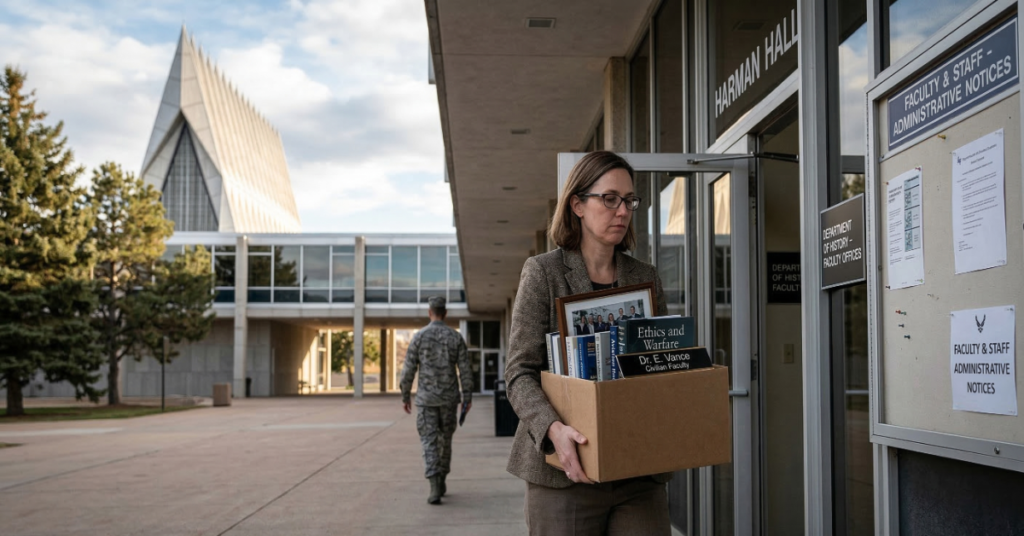

When a federal institution loses one academic in a budget cut, the gap is manageable. When it loses dozens of PhD-qualified instructors simultaneously, and replaces none of them, you are no longer looking at workforce efficiency. You are looking at institutional erosion.
That is where the US Air Force Academy stands in 2026. Between early 2025 and the end of the year, the Academy lost between 50 and 100 civilian instructors. Engineering and science departments are now short on staff. Class sizes have grown. The Higher Learning Commission has launched a formal inquiry.
The mechanism behind this drawdown was the federal Deferred Resignation Program, a Trump administration workforce-reduction tool rolled out across the Department of Defense in early 2025. At USAFA, the consequences have been disproportionate. An internal email obtained by journalists confirmed a $10 million gap in civilian pay for fiscal year 2025, with all operations-and-maintenance travel canceled to cover the shortfall. The Academy publicly maintained academic stability. Sources inside the institution described something closer to managed decline.
The story here is not simply about budget cuts. It is about what happens when a military institution built on academic excellence — one that trains the officers who will command future air and space operations — is caught between two incompatible imperatives: fiscal austerity and academic rigor. The gap between those imperatives is now being measured in empty offices, swollen course loads, and a formal accreditation review.
The Architecture of the Cuts
How the Deferred Resignation Program Reached USAFA
The Department of the Air Force launched the Deferred Resignation Program on April 7, 2025, paired with a Voluntary Early Retirement Authority. These measures offered civilian employees short-term financial incentives to resign or retire by September 30 as part of a force-management effort across the Air Force.
At the Academy specifically, the scale of targeted eliminations was striking. Of the 140 positions identified for defunding in fiscal year 2025, 36 were occupied while 104 were vacant or set to be vacated under the DRP. Through two rounds of the program, federal employees were offered the opportunity to voluntarily resign and receive paid administrative leave through the end of the fiscal or calendar year.
The official figure from USAFA leadership put departures at 25 faculty members. The figure widely cited by internal sources and external faculty advocates was more than double that. Lt. Gen. Tony Bauernfeind, the Academy’s superintendent, confirmed 25 faculty departures in 2025 — a figure sources inside the institution say is far lower than the reality. This numerical dispute reveals something important about the institutional communication strategy: manage perception, not fact.
The Departmental Impact
The damage has not been evenly distributed. Mechanical engineering dropped from 24 instructors to 16 in a single academic year. Systems Engineering reportedly went from six instructors down to three. Astronautical Engineering departments were also hit hard, with some potentially having fewer than half their previous faculty by autumn 2026.
The departure of Dr. Brian Johns illustrates the human dimension. Johns joined the Academy in 2023, having given up a tenured position at Cornell College in Iowa. In February 2025, he was told he might be dismissed the following day. The termination never happened, but months of job insecurity pushed him to look elsewhere. He resigned in August 2025 and now teaches at Colorado State University. Losing faculty who made deliberate career sacrifices to serve at a military institution is precisely the kind of institutional memory damage that cannot be reversed by a budget line.
Why Civilian Faculty Left: A Systems Analysis
Structural and Professional Drivers
| Driver | Description | Severity |
| Salary gap vs. private sector | Federal pay scales lag industry, especially in STEM | High |
| Burnout / workload | Increasing cadet-to-faculty ratios, limited support staff | High |
| Research funding constraints | Limited grant access vs. civilian universities | Medium |
| Job insecurity post-DRP | Threat of involuntary separation after voluntary program closed | High |
| Cultural friction | Military chain-of-command governance misaligned with academic norms | Medium |
| Political climate | Hegseth’s framing of civilian faculty created institutional hostility | High |
Civilian faculty began leaving in Spring 2025 after Trump appointed Pete Hegseth as Secretary of Defense. Hegseth moved quickly to ban affirmative action in admissions at the three service academies and ordered removal of diversity-focused books. Critics argue this political ideology seeped into campus culture, driving away civilian faculty who saw their expertise being devalued.
The salary-gap issue, while chronic, was sharply amplified by the $10 million civilian pay shortfall. Due to budget restrictions, the interim Dean of Faculty canceled all operations-and-maintenance funded travel — including previously approved trips — to ensure the institution could continue funding existing positions. For researchers who depend on conference participation to maintain professional relevance, this was a clear signal about institutional priorities.
The Replacement Problem
USAFA’s stated strategy was to offset civilian losses with active-duty military instructors. The execution fell short. Dr. Kent Murphy, who has served as senior pre-medical advisor at the Academy for seven years, stated: “We’ve been trying to refill positions in different departments now for months and we’re not finding almost anybody. And sometimes we find them and they don’t want to volunteer.”
While the Air Force has approximately 1,800 active-duty members with PhDs, reassigning many of them to meet a proposed 80:20 active-duty-to-civilian teaching ratio is a tall order Air Force Academy Civilian Faculty Resignations. Military officers are career-managed by assignment systems that prioritize operational billets. Teaching at a service academy, while prestigious, competes with command opportunities. The pipeline is thin.
The Accreditation Risk: What the HLC Review Means
The Higher Learning Commission review, triggered in October 2025, is the most consequential institutional consequence of the Air Force Academy Civilian Faculty Resignations. Accreditation is not a bureaucratic formality — it is the legal foundation on which USAFA degrees rest.
Timeline and Current Status
| Date | Event |
| April 7, 2025 | DRP launched across Department of the Air Force |
| Spring 2025 | First wave of civilian faculty departures |
| July 2025 | Internal email confirms 140 position eliminations, $10M pay gap |
| August 2025 | USAFA releases public statement; 25 departures acknowledged |
| October 1, 2025 | Dr. Kent Murphy files formal complaint with Higher Learning Commission |
| October 14, 2025 | HLC issues formal review letter to USAFA |
| December 2025 | Board of Visitors briefed on accreditation status |
| March 2026 | Hickenlooper and Crank write to Secretary of Air Force requesting $10M |
| 2028 | Full HLC re-evaluation scheduled |
The HLC’s October 14 letter stated it had determined the matter raised “potential concerns regarding the institution’s compliance with the Criteria for Accreditation.” The complaint argued that the departure of PhD-qualified staff was undermining the institution’s ability to teach technical subjects. USAFA was given 30 days to respond.
Three factors make this review more serious than USAFA’s public posture acknowledges. First, accreditation reviews at military institutions are rare and tend to signal deeper structural concerns that self-reporting cannot resolve. Second, if the commission determines the Academy has sufficient faculty members, the review may never become public — meaning external pressure to reform disappears regardless of underlying conditions. Third, STEM accreditation depends on demonstrable faculty credentials, and replacing PhD instructors with active-duty officers who lack doctoral qualifications leaves a measurable gap in credential Air Force Academy Civilian Faculty Resignations coverage.
Congressional Response and the Limits of Emergency Funding
Both Senator John Hickenlooper and Representative Jeff Crank sit on the USAFA Board of Visitors. In May 2025, Hickenlooper joined eight other senators to express concern about proposals to restructure the Academy’s faculty. By March 2026, concern had escalated to formal action.
Crank and Hickenlooper wrote to Secretary of the Air Force Troy Meink, requesting $10 million from unobligated operations and maintenance funds to cover the pay shortfall for civilian staff Air Force Academy Civilian Faculty Resignations. While acknowledging the need for resource management, they warned that rushed civilian staff cuts hurt academic continuity by increasing class sizes, shrinking course offerings, and eroding accreditation in technical disciplines.
But the academic hiring cycle creates a structural lag that money alone cannot close. Any new hires arriving in Fall 2026 will spend their first year learning the institution’s Air Force Academy Civilian Faculty Resignations systems. Effective teaching depth in technical disciplines will not recover before the 2027–2028 academic year at the earliest.
Former visiting professor Tom Bewley put it plainly: “Money alone is not going to fix the problem.” He noted that a civilian provost — a role that exists at the Air Force Institute of Technology — could help provide needed continuity to academic departments.
Three Insights Not in the Standard Coverage
1. The Accreditation Silence Loop.
USAFA’s incentive structure around the HLC review is perverse. If the commission closes the matter after receiving the Academy’s internal response, the review never becomes public. This means there is no external forcing function on honest faculty reporting. Alumni advocates and congressional oversight are currently the only independent correctives.
2. The 80:20 Ratio Is an Operational Fiction.
The stated ambition of an 80% active-duty teaching ratio cannot be achieved without either gutting STEM course depth or accepting instructors without doctoral credentials. The Air Force’s own data — roughly 1,800 PhD-holders among active-duty members — suggests a structural ceiling well below what the ratio implies. This ratio functions as an ideological signal, not an operational plan.
3. The Board of Visitors Reporting Gap.
The Academy’s Board of Visitors semiannual report called for an audit of current faculty and for assessing requirements to increase enrollment from about 4,000 cadets to 4,400. This enrollment increase goal runs directly counter to the faculty reduction logic. These two institutional goals are not being reconciled in any public document.
The Future of USAFA Academic Staffing in 2027
Dr. Murphy’s assessment was direct: “We’re barely gonna hold it together for 2026 and we think 2027 is gonna be an absolute collapse.” That is not an analyst’s projection. It comes from someone who has spent seven years navigating the institution’s academic departments and is willing to accept professional consequences for saying it publicly.
Several converging dynamics will define 2027. The hiring cycle cliff means faculty who departed in Spring 2025 took institutional knowledge that takes years to rebuild. Any new hires arriving in Fall 2026 will spend their first year learning systems, not teaching at full depth. The accreditation midterm review — scheduled before the 2028 full HLC evaluation — will test whether USAFA can demonstrate measurable progress on faculty credentialing. If not, escalated oversight becomes likely. Finally, the Air Force Academy Civilian Faculty Resignations: the pace of civilian cuts has been shaped more by ideology than operational necessity. Should the Defense Department’s posture shift, a reversal is possible — but the institutional trust damage with prospective civilian faculty is already done.
The Academy’s long-term risk is not a single dramatic failure. It is a slow degradation of the academic quality that makes its commissions worth competing for. If USAFA graduates enter the Air Force with weaker technical grounding than counterparts at civilian engineering schools, the national security implications — in a domain increasingly defined by AI, space systems, and cyber operations — are not abstract.
Takeaways
- Civilian positions vacated through the DRP disappeared entirely — none were backfilled, making each departure a permanent structural reduction.
- The official count of 25 faculty departures diverges significantly from source-based estimates of 50–100; the Academy’s refusal to dispute the higher figures is telling.
- A $10 million civilian pay shortfall forced cancellation of all operations-and-maintenance travel, signaling fiscal stress well beyond the faculty headcount debate.
- Replacing PhD-credentialed civilian faculty with active-duty officers is constrained by both pipeline depth and assignment-system incentives outside the military chain of command’s control.
- The HLC accreditation review is potentially self-sealing: if managed successfully internally, no public record is created, eliminating an independent accountability layer.
- Congressional bipartisan support for emergency funding is meaningful but structurally insufficient — hiring cycle lags mean Spring 2026 money cannot repair Fall 2026 classrooms.
- The enrollment expansion goal (4,000 to 4,400 cadets) and the faculty reduction program are irreconcilable without a strategic course correction that has not yet been announced.
Conclusion
The US Air Force Academy has spent decades building an academic reputation that could compete with the country’s leading engineering and science programs. That reputation was not incidental — it was the mechanism by which the Academy attracted the faculty and cadets who made its commissions valuable to the Air Force. The civilian faculty who left in 2025 took that mechanism with them, piece by piece.
What makes this story structurally unusual is that the damage was inflicted through a voluntary program, at institutional speed, without public deliberation. No single decision triggered it. No dramatic confrontation made headlines. The vacancies simply accumulated, the positions disappeared, and the course catalog held together through the effort of faculty carrying unsustainable workloads.
Emergency funding and bipartisan letters are appropriate responses. They are not sufficient ones. What USAFA needs — and what no budget line can provide — is an institutional commitment to civilian academic expertise that is legible, durable, and insulated from the next political wind. Whether that commitment is forthcoming before the 2027 collapse that internal observers are already describing as likely is the central question the Air Force has yet to answer.
Methodology
This article was produced through analysis of primary and secondary source reporting published between April 2025 and March 2026. Core sources include field reporting from KOAA News (Colorado Springs), The Denver Post, Air & Space Forces Magazine, Military.com, and official USAFA press releases. Internal documents — including the interim Dean of Faculty’s July 2025 email confirming the $10 million pay gap — were verified through multiple independent outlet references. Faculty accounts were gathered from sources who spoke on condition of anonymity, cross-referenced across multiple outlets. Limitations: USAFA has not published precise faculty counts by department; discrepancies between official figures and source-based estimates could not be fully resolved from publicly available records.
Frequently Asked Questions
What is the Deferred Resignation Program and why did it affect USAFA?
The DRP was a Trump administration initiative offering civilian federal employees paid leave through fiscal year-end in exchange for voluntary resignation. At USAFA, 140 civilian positions were targeted for elimination in FY2025, and positions vacated under the DRP were not refilled.
How many civilian faculty actually left?
Official figures cited 25 departures. Sources including former faculty and department chairs reported the number exceeded 50, with fears of further involuntary cuts that could double or triple the total.
What is the Higher Learning Commission review, and what could it mean?
The HLC is USAFA’s regional accreditor. In October 2025, it opened a formal review after an alumnus complaint. If compliance issues are found, it can escalate to enhanced monitoring, probation, or — in extreme cases — accreditation withdrawal.
Why can’t the Air Force simply replace civilian faculty with military instructors?
The replacement strategy is constrained by pipeline limitations — only approximately 1,800 active-duty members hold PhDs — and assignment-system incentives that route career-focused officers away from teaching billets.
What did Congress do in response?
Senator Hickenlooper and Representative Crank wrote to the Secretary of the Air Force in March 2026 requesting $10 million in emergency funding and warning of risks to academic continuity and accreditation.
Will the $10 million fix the staffing problem?
Not immediately. Academic hiring cycles mean positions posted in Spring 2026 cannot be filled before Fall 2026 at the earliest. Insiders have also called for structural governance changes including a civilian provost role.
What happens if USAFA cannot restore faculty levels before 2027?
Internal observers have described a potential collapse of academic depth in 2027, particularly in STEM departments. The HLC midterm review before 2028 will be the critical checkpoint.
References
Cohen, R. S. (2025, August 21). Air Force Academy keeps majors intact amid faculty cuts. Air & Space Forces Magazine. https://www.airandspaceforces.com/air-force-academy-majors-intact-faculty-cuts/
Forster, B. (2025, July 2). Sources: Over 50 civilian instructors have already left Air Force Academy with no replacements. KOAA News5. https://www.koaa.com/advocates-of-accountability/sources-over-50-civilian-instructors-have-already-left-air-force-academy-with-no-replacements-more-feared
Forster, B. (2025, July 4). Internal email confirms Air Force Academy cutting 140 civilian staff, facing $10 million pay shortage. KOAA News5. https://www.koaa.com/advocates-of-accountability/internal-email-confirms-air-force-academy-cutting-140-civilian-staff-facing-10-million-pay-shortage
Forster, B. (2025, August 29). Speaking out: Air Force Academy advisor says plan to replace civilians with military faculty isn’t working. KOAA News5.
Hewitt, J., & Migoya, D. (2025, November 10). Air Force Academy’s accreditation under review after cuts to civilian faculty. The Denver Post. https://www.denverpost.com/2025/11/10/air-force-academy-accreditation/