
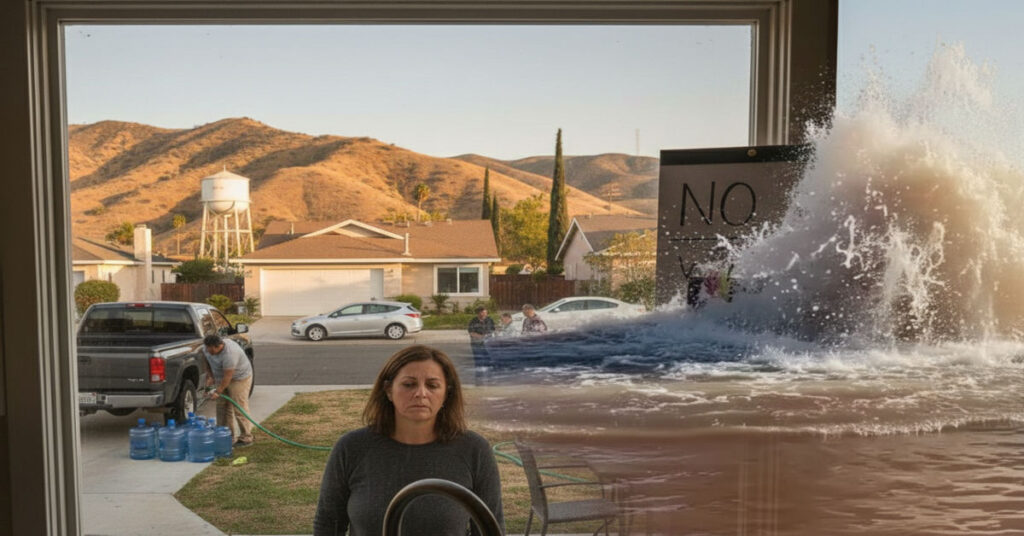

In early August 2025, a major water outage struck the northern San Fernando Valley communities of Granada Hills and Porter Ranch, leaving roughly 9,200 Los Angeles Department of Water and Power (LADWP) customers without reliable water service for days. This disruption was not a simple main break or a short interruption but a complex infrastructure failure tied to a 54‑inch trunk pipeline valve that failed while crews were performing maintenance at a pump station linked to a 10‑million‑gallon storage tank serving the area.
Community members were desperately seeking reliable water, boiling instructions and resource locations after the valve failure cut off flow into the distribution network. Utilities and public safety officials immediately implemented a boil water notice for drinking and food preparation, while urging residents to conserve water, refrain from irrigation use and rely on bottled water for basic needs.
The outage affected an area bounded by Rinaldi Avenue to the south, Balboa Boulevard to the east, De Soto Avenue to the west and the foothills to the north. Repair efforts were complicated by the valve’s depth—more than 20 feet below ground—and its proximity to critical infrastructure including oil pipelines, gas lines and fiber optic cables. Excavation and replacement required careful coordination to avoid cascading infrastructure risks, a dimension rarely visible to residents but paramount to technical teams on site.
This article unfolds how this outage revealed vulnerabilities in aging water systems, the operational challenges utilities face in real time and how communities adapted under pressure.
Anatomy of the Failure and Technical Barriers
The heart of the outage was a single large valve controlling flow to the main water tank. During routine repairs early August 5, 2025, the valve broke and failed to reopen, cutting off water to the 54‑inch trunkline serving Granada Hills and Porter Ranch.
At repair sites, crews encountered significant obstacles. The valve sat 20 to 24 feet below the surface within a trench crowded with oil and gas pipelines, fiber optic infrastructure, and stubborn boulders. This created a constrained risk surface where heavy excavation risked destabilizing nearby systems. Engineers had to map, expose and protect adjacent lines before digging further, slowing what is often considered a straightforward replacement.
Expert civil engineer Maria Torres observed, “Failures at this depth intersect multiple utility corridors, making excavation not just a matter of digging but of cross‑utility coordination that can easily double the timeline.” Another water system specialist, John Patel, noted, “Valve failures of this scale are rare but when they occur, they expose the challenge of redundant isolation points in legacy networks.” A regional water quality director added, “Ensuring safe water under pressure fluctuations and after outages is as critical as restoring flow itself.”
These technical barriers extended timelines, forcing crews to work around the clock to both locate the valve precisely and prepare it for safe extraction.
How Residents and Water Managers Responded
Amid the outage, LADWP established multiple support sites distributing bottled water, recycled water for non‑potable use, mobile showers and laundry facilities. Holleigh Bernson Memorial Park in Porter Ranch and O’Melveny Park in Granada Hills served as primary hubs for resource distribution. Additional stops included intersections near Tampa Avenue and the YMCA in Porter Ranch for higher‑need services.
Residents reported pivoting to bottled water and employing conservation measures. A local small business owner said, “We shifted entirely to bottled water, paused dishwashing operations and offered neighbors rides to distribution points.” Many turned off irrigation, fixtures and appliances to aid restoration. Peer‑to‑peer communication buzzed across community forums with neighbors coordinating rides, sharing water and troubleshooting fallout from the outage.
Water managers emphasized the importance of conservation. LADWP repeatedly urged residents not to use tap water even when pressure was restored to stabilize tank refill rates, stressing how every gallon consumed slowed repressurization and extended boil orders.
Timeline of Outage and Repair Progress
| Date | Event |
| Aug 5, 2025 | Valve fails during maintenance cutting water to system. |
| Aug 6, 2025 | Boil water notice issued as crews begin deep excavation. |
| Aug 7–9, 2025 | Conservation urged, resource sites operational. |
| Aug 10, 2025 | Crews remove broken valve section and begin pipe welding. |
| Aug 11, 2025 | Full service restored; boil notice remains pending testing. |
| Aug 12, 2025 | Boil water notice lifted after testing. |
This timeline reveals how a technical break evolved into a multi‑day outage only resolved through strategic coordination and staged restoration efforts.
Distribution Sites and Support Services
Residents faced an unusual need for alternative water access. Resource centers set up across the affected neighborhoods provided essential services. They distributed bottled drinking water and recycled water for irrigation. Mobile facilities offered showers and laundry for those heavily impacted by prolonged low or no water pressure.
| Location | Services Provided |
| Holleigh Bernson Memorial Park | Bottled water, restrooms, showers, mobile laundry. |
| O’Melveny Park | Bottled and recycled water, restrooms. |
| Tampa Ave & Sesnon Blvd | Bottled and recycled water. |
| YMCA Porter Ranch | Showers and laundry units. |
| Rinaldi & Louise Ave | Showers and restrooms. |
Communication Strategies and Public Messaging
LADWP and city officials used Wireless Emergency Alerts, social media and direct notices to push updates. Officials emphasized water safety, urging boil procedures for drinking and cooking until quality testing was complete.
A city emergency coordinator said, “Rapid communication reduced confusion and helped residents adapt quickly.” Residents widely shared interactive maps allowing address checks for boil notices.
Clear messaging helped temper misinformation and reduce unsafe behaviors such as irrigation that could reduce system pressures. Officials maintained transparency about evolving conditions and safety protocols over several days.
Economic and Operational Impacts
The outage stressed small businesses dependent on water like coffee shops and child care centers. Many temporarily reduced hours or relied solely on bottled supplies. Nearby gyms and laundry services saw extra demand.
Utility teams incurred overtime while coordinating cross‑agency support, pumping equipment from neighboring systems, and conducting extensive safety testing after restoration. The operational cost and logistical complexity spotlighted the hidden economics of water infrastructure resilience.
Lessons for Urban Water Systems
The outage underscores the importance of redundancy in critical valves and easier access to major components. Aging infrastructure deep underground may lack modern access points, complicating emergency repairs. Strategic planning and investment in replaceable isolation points could reduce future disruption risk.
Another takeaway is the value of conservation and public cooperation. Rapid compliance with conservation requests helped stabilize system pressures more quickly.
Takeaways
• A single deep‑buried valve failure can disrupt service for thousands.
• Interdependent infrastructure complicates repairs and timelines.
• Public cooperation in water use reduction directly aids restoration.
• Transparent communication improves safety and community response.
• Boil water notices are crucial until testing certifies safety.
Conclusion
The Granada Hills and Porter Ranch water outage was a rare but revealing disruption in a major urban utility network. It demonstrated how deeply buried infrastructure failures interact with broader system risks, requiring careful excavation and coordination and extended support for residents. The prolonged outage also highlighted how community cooperation and clear communication can shape utility recovery. As Granada Hills Porter Ranch Water Outage systems age and environmental pressures grow, planning for similar disruptions will be essential to build resilient and responsive services.
FAQs
Why was water service lost in Granada Hills and Porter Ranch?
A large control valve failed during maintenance at a pump station, cutting flow into a 54‑inch main and isolating water service for thousands.
What does a boil water notice mean?
It means tap water must be boiled before drinking or cooking until testing confirms it meets safety standards.
How long did the outage last?
Service was restored by August 11, with the boil notice lifted August 12 after safety testing.
Where could residents get water during the outage?
Distribution sites at parks and intersections provided bottled and recycled water, showers and laundry units.
Did this outage affect firefighting capacity?
Officials confirmed fire hydrants met firefighting standards once service returned.
References
City of Los Angeles. (2025, August 12). Boil Water Notice lifted after safety testing. CD12. https://cd12.lacity.gov/articles/boil-water-notice-lifted-after-safety-testing
Los Angeles Department of Water and Power. (2025, August 11). Water service restored to Granada Hills & Porter Ranch customers. LADWP News. https://www.ladwpnews.com/water-service-restored-to-granada-hills-porter-ranch-customers-boil-water-notice-remains-in-effect
Los Angeles Department of Water and Power. (2025, August 8). LADWP urges Granada Hills and Porter Ranch customers: Do not use tap water. LADWP News. https://www.ladwpnews.com/ladwp-urges-granada-hills-and-porter-ranch-customers-do-not-use-tap-water-to-help-us-restore-service
Los Angeles Department of Water and Power. (2025, August 6). Boil Water Notice in effect as crews continue repairs. LADWP News. https://www.ladwpnews.com/granada-hills-porter-ranch-water-incident-update-4-august-6-2025-pm-update
Los Angeles Department of Water and Power. (2025, August 10). Crews make major progress to restore water service. LADWP News. https://www.ladwpnews.com/crews-make-major-progress-to-restore-water-service-to-granada-hills-porter-ranch-customers